
Connect marketing attribution to lead quality by agreeing three definitions: the action the website accepted, the enquiry record the business created and the evidence that makes it qualified. Preserve the campaign information through that handover, then report the same group of enquiries at a stated review date. Keep missing sources and unfinished assessments visible.
A dashboard showing more leads cannot tell you whether the sales team received more useful enquiries unless those definitions line up. Begin with a small reconciliation that someone can inspect. It will often reveal a concrete collection, handover or follow-up question before you need another attribution model.
Choose one decision, such as reviewing the relevance of a campaign's enquiries or identifying where follow-up is incomplete. “Prove marketing works” is too broad to specify a useful report. Record who will use the result, what they may change and what evidence would be insufficient for that change.
Agree qualification with the receiving team. A service enquiry might qualify when its stated need fits an agreed offer and the necessary business information is available. The exact criteria belong to that business. A page view, a contact-button click and a completed assessment are separate milestones; none should silently inherit another's label.
Google defines attribution as assigning credit across interactions leading to an important action. Treat the resulting allocation as a modelled account of the observed journey. A claim that a campaign created additional demand needs a suitable causal evaluation; changing the credit model alone does not supply that evidence.
In GA4, traffic-source scope changes the question. First-user dimensions describe acquisition of the recorded user; session dimensions describe acquisition for a session; event-scoped attribution applies the selected model to relevant key-event reporting. The same journey can therefore appear under different sources without either report being a transcription error.
Record the exact dimension and metric beside every chart. Do not shorten First user source and Session source to an indistinguishable “Source” heading. User identity also depends on the property's reporting identity and available browser or device information. A recorded analytics user is not a promise of a complete, enduring view of one real person across every visit.
The GA4 lead acquisition report uses user-scoped channel dimensions. Its new, qualified and converted lead metrics count unique users with the corresponding events: generate_lead, qualify_lead and close_convert_lead. Those are not automatically counts of distinct CRM enquiries, nor a live inventory of each record's current stage.
That distinction matters when one person makes two enquiries or a previously qualified enquiry is later rejected. An event records something that happened under the implementation's rules; a current CRM status describes a record at the chosen time. Define which view the report needs, rather than forcing their totals to match. The tracking audit guide helps test the underlying acceptance and event path.
Use this original worksheet before building the dashboard. Name the system of record and the owner for every row. “Available somewhere” is not an acceptance check: a reviewer should be able to trace a controlled enquiry from its entry route to its recorded outcome.
| Reporting field | Definition to agree | Acceptance evidence |
|---|---|---|
| Enquiry identity | One accepted enquiry, including the duplicate rule | A controlled submission maps to the intended CRM record |
| Creation cohort | The creation period, timezone and inclusion rules | Records outside the period are excluded consistently |
| Acquisition reference | The exact campaign/source fields and their scope | A tagged test path retains the expected values |
| Qualification | Required evidence, responsible team and rule version | An assessor can explain a qualifying and rejecting example |
| Status timing | Event date, current status and review cutoff | A later stage change is represented according to the chosen view |
| Missing data | Separate reasons for absent source or failed linkage | Unknown records remain visible and can be investigated |
| Follow-up | Assessment status and agreed response ownership | Pending records have an owner and a next action |
| Reporting access | Who may see record details or only aggregates | Access matches the information needed for the task |
Google's tagging guidance explains how manual campaign parameters and integrated auto-tagging supply traffic-source dimensions. A tagged URL does not by itself build a reliable connection to a CRM record. Test redirects, language changes and the actual submission route, including what happens when source information is absent.
Keep contact details in the systems approved to handle them. Do not put names, email addresses, phone numbers or free-text enquiries into ordinary analytics URLs or event parameters; Google's PII guidance sets relevant collection restrictions. Review any proposed identifier against the specific supported integration and its requirements. Hashing a value is not blanket permission to send it anywhere.
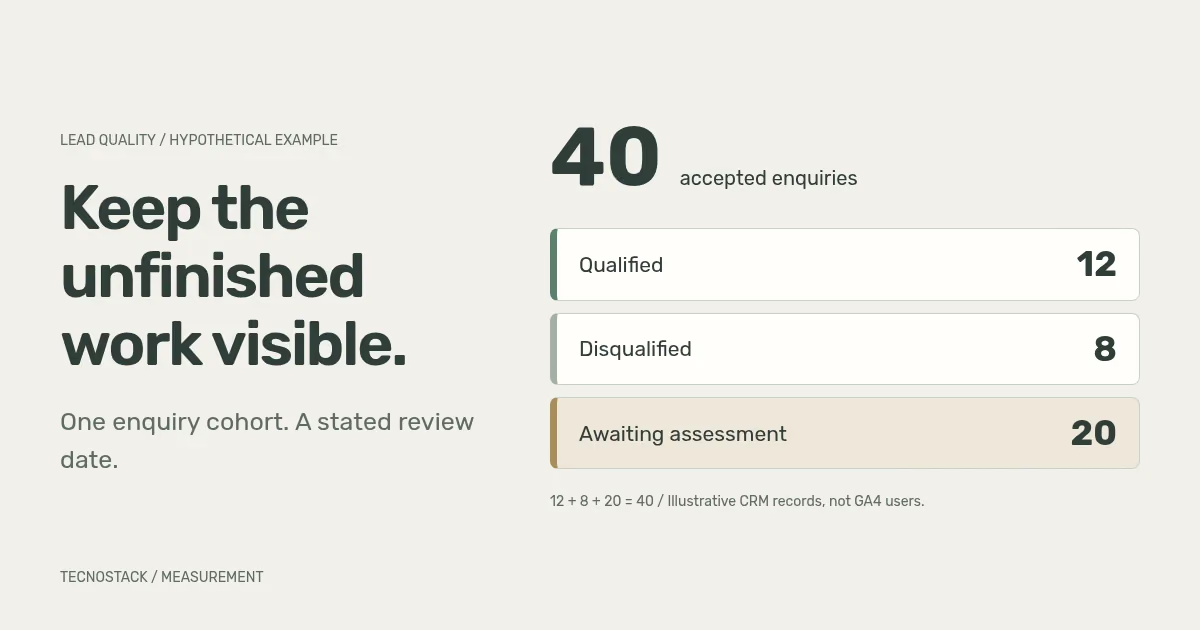
Here is an entirely hypothetical working example, not a client result or a benchmark. A team reviews 40 distinct accepted CRM enquiry records created during one agreed week, using a stated cutoff the following week. Each record appears once and has exactly one status at that cutoff. The source classification follows the team's documented CRM mapping, not a copied GA4 channel total.
| CRM source classification | Accepted records | Qualified | Disqualified | Awaiting assessment |
|---|---|---|---|---|
| Paid campaign, source recorded | 10 | 4 | 2 | 4 |
| Organic search, source recorded | 15 | 5 | 3 | 7 |
| Source unknown | 15 | 3 | 3 | 9 |
| Total | 40 | 12 | 8 | 20 |
The rows reconcile: 12 + 8 + 20 = 40. Source coverage is 25 / 40 = 62.5%; the remaining 15 records retain their unknown label. The qualified share of the whole accepted cohort is 12 / 40 = 30% at this cutoff. Among the 20 already assessed records, it is 12 / 20 = 60%. These percentages answer different questions.
Do not present 60% as the expected final qualification rate for all 40. Half the cohort is still awaiting assessment, and the order in which records were assessed might matter. Likewise, four qualified paid enquiries versus five organic enquiries does not establish which channel deserves more budget. The samples are small, assessment is incomplete and source coverage has gaps.
The immediate operating questions are useful: who owns the 20 pending records, why are 15 sources unknown, and does the same qualification rule apply across the group? Preserve the original snapshot and record the next review date. An updated snapshot can then show how the same cohort matured without rewriting its earlier state.
Separate a creation-cohort report from a qualification-date report. “Enquiries created this week that have qualified by the cutoff” differs from “enquiries qualified this week”, which may include records created months earlier. Both can be useful, but dividing one by the other's denominator produces an ambiguous rate.
Before adding cost per qualified enquiry, define the included spend, campaign mapping, currency, period and treatment of later outcomes. A spend total for one window and qualification events for another do not become comparable because they sit in adjacent columns. Keep unmatched spend or unmatched records visible; do not assign them to a convenient campaign to close the report.
If systems disagree on status ownership, solve that handover explicitly. The CRM and ERP ownership guide provides a field and failure worksheet. A dashboard cannot settle two teams' competing definitions of the authoritative customer record.
Choose a bounded next action: correct a missing campaign field, repair duplicate creation, assign overdue assessments or investigate an audience mismatch. Give that action an owner and a repeatable acceptance check. Keep observed operational improvements separate from claims about incremental campaign performance.
If the next question requires an experiment, review the available sample and stopping method first. The low-traffic testing guide explains why a short calendar deadline cannot guarantee a conclusive answer. Other causal designs have their own assumptions; an attribution dashboard does not remove the need to examine them.
For a scoped review, bring one campaign path, the receiving process, the current qualification definition and a redacted reporting example. Our analytics and conversion optimisation service can define the measurement and implementation work around that decision. We review existing website and marketing inclusions before proposing additional work, with the deliverables and acceptance criteria agreed in scope.


