Is selling online in the Gulf a real opportunity for your business? A regional market-size figure can't tell you. The answer depends on whether orders in a specific country and category, through a specific channel, leave money after product, payment, delivery and return costs, and on whether customers can pay and receive their orders the way they expect. Those factors differ between Saudi Arabia, the UAE and the other GCC markets, and between categories.
This guide replaces headline sizing with an evaluation you can run before committing to a regional launch. The figures you use must come from your own quotes, data and advisers; what transfers is the structure of the calculation.
A regional total blends six countries, many categories, marketplaces and brands' own stores, and different definitions of what counts as e-commerce. Even a sound estimate describes everyone's orders, not yours. It can't tell you what delivery will cost in a particular city or how often customers in your category send items back.
Official statistics help when you read them for exactly what they measure. The Saudi Central Bank (SAMA) reported that electronic payments made up 85% of the number of retail payment transactions in Saudi Arabia in 2025, up from 79% in 2024. That suggests paying electronically is now normal at retail checkouts, so card and wallet acceptance deserves attention. It counts transactions rather than their value, and it does not measure e-commerce sales or how much shopping happens online.
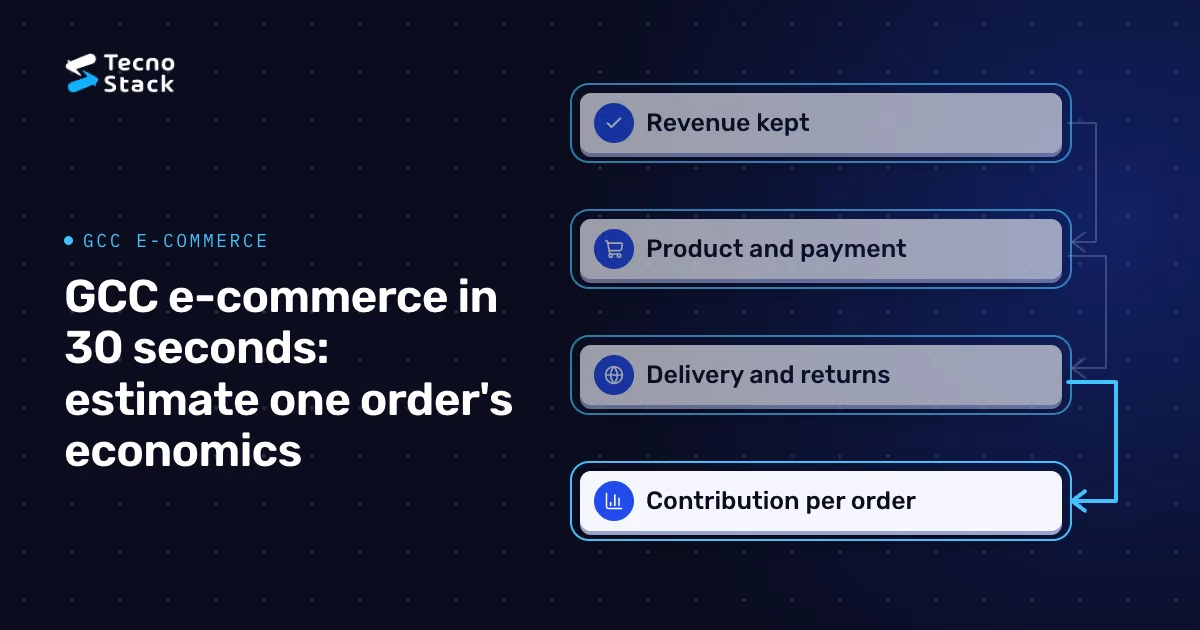
Start with one typical order and follow its money. Keep three things apart: the revenue you actually keep, the costs that rise with each order, and the fixed costs of running the business.
Revenue you keep. Start from the basket price after discounts. If prices include VAT, take it out: you collect VAT for the tax authority, so it is not revenue you retain. Then reduce revenue by the refunds you expect, based on the return rate for that category.
Variable costs per order:
- Products and packaging: include products customers keep and nonrecoverable packaging used for all shipped orders. Returned products that can be resold go back into stock.
- Payment costs: processing fees for each method you offer, plus chargebacks and failed payments.
- Delivery: first attempts, failed attempts and remote areas, priced from quotes by carriers that serve your target cities.
- Return handling: reverse shipping, inspection, repackaging and the cost of returned items that can't be resold. The refunded money itself is counted once, as the revenue reduction above, not again here.
- Pick-and-pack and support charges where a provider bills per order or per contact.
Revenue kept minus these variable costs is your contribution per order before marketing.
Fixed and capacity costs stay outside that line: for example, base platform subscriptions, staffing, a warehouse lease, compliance and integration work. Some step up as volume grows, so estimate them at your planned operating scale. Total contribution across all orders has to cover them, so estimate how many orders it takes at a given contribution, rather than hiding that dependency inside a single per-order figure.
A heavy, low-priced product can lose money on delivery and returns even when demand is strong, while a small, higher-value item may absorb the same costs comfortably. Run the numbers for each country, because carriers, distances, currencies and tax rules differ. These are planning estimates, not accounting statements; how costs are recorded is a question for your accountant.

Figure 1 — Estimate contribution before marketing. Fixed costs remain separate.
Marketing cost per order deserves its own line because it behaves differently from everything above. Ask two separate questions:
- Does the first order contribute after acquisition? If the contribution from a new customer's first order covers what it cost to win that order, acquisition can pay for itself even if the customer never returns.
- What do repeat orders add? Later orders may cost less to win, but do not assume it: retention offers, messages and campaigns still cost something. Measure how many customers return and what their orders contribute, by cohort.
If first orders lose money after acquisition, the plan depends on repeat purchases, and you should see evidence of them before scaling spend. Acquisition cost can also fall without any repeat purchase, through better targeting, a checkout that converts more visitors, or organic channels, so track it by channel instead of assuming one figure.
A checkout that lacks the customer's preferred payment method can lose the order at the last step. For each country, list the methods your target customers use, which may include local debit schemes such as mada in Saudi Arabia, international cards, digital wallets, pay-later services or cash on delivery. Then confirm with your payment provider which of them it supports for your business and in which countries; don't assume availability from a platform's marketing page.
Test the unglamorous paths before launch: declined cards, authentication challenges, partial refunds, refunds to a pay-later plan and failed cash collections. Build the Arabic checkout as carefully as the English one, with right-to-left forms, local phone and address formats, and error messages written in Arabic rather than translated literally.
A pay-later provider's latest funding round, however large, says little about your customers' behaviour or your costs. Our analysis of what Tabby's funding announcement does and doesn't prove looks at that distinction.
Delivery and return costs can undermine otherwise promising demand. Decide early:
- Where inventory sits: a local warehouse, a third-party fulfilment centre, or cross-border shipping with customs and duties.
- The delivery promise for each city: promise what your carriers achieve consistently, not what the fastest competitor advertises.
- Address quality: collect structured addresses and a reachable phone number, and confirm details before dispatch to reduce failed deliveries.
- Returns policy: confirm applicable consumer rights with a local adviser, then define the window, condition rules and return-shipping responsibilities accordingly. State the policy clearly in both languages before purchase.
Track delivery success, delivery time and return rates by city and category from the first order. Those figures, not a market report, will tell you whether a market works for you.
In Saudi Arabia, the Zakat, Tax and Customs Authority (ZATCA) runs an e-invoicing programme with a generation phase and an integration phase. The integration phase is applied to taxpayer groups in waves. Whether and when your business must integrate, and the technical requirements, are questions to settle using ZATCA's guidance and your tax adviser. Choosing a storefront platform does not make you compliant on its own: invoices may come from your commerce platform, an ERP or accounting software, and the integration has to be specified and tested end to end. The platform decision changes who builds and operates integrations like this, which our comparison of Shopify Hydrogen and headless Medusa covers in detail.

Figure 2 — Test the local buying journey. Check payment, delivery and invoicing.
A staged entry turns assumptions into evidence:
- Choose one country and one category where you have a real advantage in supply, brand, price or service.
- Launch narrowly through your own store, a marketplace listing or both, with the payment methods and delivery options your research supports.
- Replace estimates with actuals: recalculate contribution per order using real payment, delivery and return costs.
- Read first-order and repeat results separately, by acquisition channel and customer cohort.
- Expand to the next city or country when the economics hold, and repeat the evaluation there.
If your analytics show that most customers shop on their phones, a fast mobile web checkout usually matters more at launch than an app; our guide to choosing between a PWA and a native app covers when an app becomes worth building.
GCC e-commerce rewards teams that know their numbers for each country and category. If you are planning a store, our e-commerce development service plans the platform, storefront and checkout together, in Arabic and English.
- Saudi Central Bank (SAMA). E-payments in 2025: electronic payments as a share of the number of retail payment transactions in Saudi Arabia, 2025 compared with 2024.
- Zakat, Tax and Customs Authority (ZATCA). Phase 2: How to get ready?: the e-invoicing phases, implementation waves and requirements.
Payment, tax and delivery conditions change and differ by country, so confirm them with providers and advisers. This article is TecnoStack's general planning guidance, not accounting, legal or tax advice, and no approach guarantees a profitable launch.