On 14 September 2026, Tabby announced that it had raised $233 million at a $6.5 billion valuation. Nineteen months earlier, in February 2025, it had announced a $160 million Series E at a $3.3 billion valuation. For anyone building or buying fintech in the region, the useful question is not how big the numbers are but what they actually tell you. A funding round shows that investors agreed to buy a stake at a price. It does not show that a product works, that customers in your market want it, or that a similar business would succeed.
This article separates what the announcements support from what they don't, then sets out the readiness work that no funding headline settles.
Both figures come from Tabby's own newsroom and should be read as company announcements:
- 12 February 2025: a $160 million Series E at a $3.3 billion valuation.
- 14 September 2026: $233 million at a $6.5 billion valuation.
On the company's figures, its announced valuation nearly doubled between the two rounds. This article relies only on those amounts, valuations and dates. Operating figures shared in an announcement are company-reported; this article has not established whether they were independently audited. They are not a substitute for financial statements. The September announcement also says the transaction remains subject to regulatory approvals, including SAMA's, and includes an employee liquidity option. It therefore should not be read as confirmation that the full headline amount is already available as new operating cash.

Figure 1 — Read dated announcements carefully. Check closing conditions and deal terms.
A round does establish a few things. Investors were willing to commit capital at that price, on terms that announcements rarely disclose in full. Once a primary investment closes, it can add capital for marketing, merchant incentives or products. Secondary share sales pay selling shareholders instead. Check closing conditions and the mix before inferring new operating cash; competitors and partners can plan for possible expansion without assuming it has already happened.
It does not establish:
- Revenue or profitability. A valuation is an implied company value, not a measure of income or the cash raised.
- Demand in your segment. Strong investor interest in one provider says little about whether your customers, in your country and category, want the same product.
- Unit economics. Credit losses, funding costs, fraud and support decide whether a pay-later product makes money on each transaction, and outsiders can't see them in an announcement.
- That a copy would raise money. Investors back a specific team, position and timing.
- What happens next. A round is not a forecast, and this article is not investment advice.
Headline valuations of private companies also depend on terms, such as liquidation preferences, that outsiders rarely see. Two valuations are therefore not always directly comparable, even when they come from the same company.
Some public data is more useful than funding news for product decisions, as long as you read it precisely. The Saudi Central Bank (SAMA) reported that electronic payments made up 85% of the number of retail payment transactions in Saudi Arabia in 2025, up from 79% in 2024. That tells you electronic payment accounts for most retail payment transactions. It counts transactions, not their value; it says nothing directly about pay-later usage or online sales; and it covers Saudi Arabia, not the whole region.
Used carefully, a figure like this can justify investing in a strong electronic checkout. It can't size a fintech market or validate a particular product.
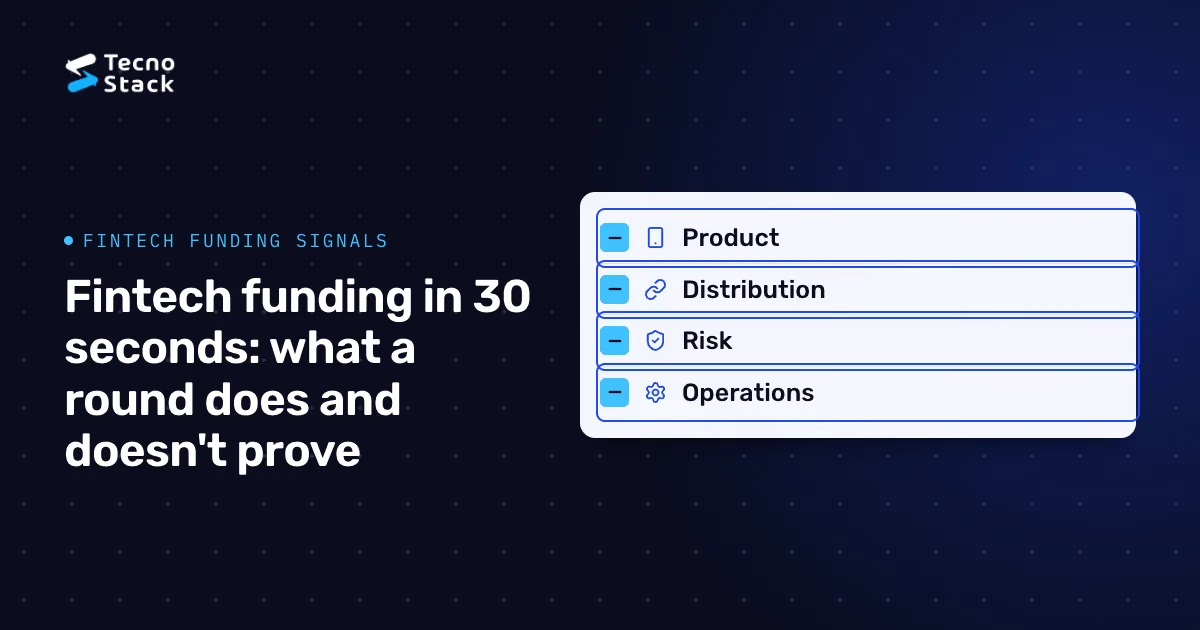
Whether you are building a fintech product or adding financial features to an existing one, these are areas we recommend reviewing before scaling. Someone else's funding round answers none of them.
Product
Define the specific problem and the user who has it. Map the full journey rather than the happy path alone: approval and decline, partial refunds, disputes, missed payments and account closure. Build the Arabic experience natively, with right-to-left forms and clear decline and repayment messages, and test both languages with real users.
Distribution
Decide how the product reaches people. Merchant-facing products need integrations that fit where merchants already sell, such as commerce-platform plugins, APIs and clear onboarding. Consumer products need a channel whose cost per active user you can measure. If distribution depends on one partner, plan for what happens when that partner changes its terms.
Risk
Credit, fraud and compliance risk sit at the center of most financial products. Model losses conservatively, monitor them by customer cohort, and design fraud controls with the customer experience in mind. Licensing and regulatory requirements depend on the product and the country, so confirm them with the relevant regulator and qualified counsel before launch, not after.
Operations
The work that grows with volume decides whether the product holds up: reconciliation and settlement with merchants, collections, customer support in Arabic and English, refunds, incident response and monitoring. Rehearse failure cases, such as a settlement file that doesn't balance or a payment-provider outage, before customers find them.

Figure 2 — Review four readiness areas. Assess each before scaling.
A provider's funding round shouldn't decide whether you add it to your checkout. Ask instead whether your customers want the option, what it costs per order in fees, how and when you are settled, how refunds to a pay-later plan work, and how declines appear to the shopper. Test failure cases in the provider's sandbox, then use a controlled live pilot, then judge it with the per-order view described in our guide to evaluating GCC e-commerce through unit economics.
Funding news is a useful signal of investor appetite, provided you know its limits. Our reading of MAGNiTT's public FY2025 venture summary applies the same discipline to regional totals. For builders, the more consequential choices are often closer to home, such as which components to build and which to buy; our framework for choosing between SaaS and custom software can help with that decision.
If you are building the customer-facing web experience for a fintech product, our website design and development service can help you design and build it in Arabic and English.
- Tabby. Equity round announcement, 14 September 2026: $233 million at a $6.5 billion valuation.
- Tabby. Series E announcement, 12 February 2025: $160 million at a $3.3 billion valuation.
- Saudi Central Bank (SAMA). E-payments in 2025: electronic payments as a share of the number of retail payment transactions in Saudi Arabia, 2025 compared with 2024.
Funding and valuation figures are the company's own announcements. This article is TecnoStack's general analysis, not investment, legal or financial advice.