What does the UAE's AI strategy mean for a company that builds AI products or services? Start by separating three things that are often blended together. The UAE National Strategy for Artificial Intelligence 2031 is a government policy document that sets national ambitions. MGX is a technology investment vehicle, announced in 2024 with Mubadala and G42 as founding partners. And procurement opportunities are specific buyers with budgets, requirements and processes. A strategy doesn't commit anyone to buy from you, and an investment vehicle isn't a grant program. The work you can win comes from named buyers that you find and qualify yourself.
Articles about national AI programs often put policy documents, investors and buyers on the same slide. They behave very differently:
- Strategy sets direction: priorities, sectors and ambitions over a period.
- Investment vehicles allocate capital according to their own mandates, to companies and assets they choose.
- Procurement is a specific organization buying a specific solution through its own process, with a budget and a decision owner.
A builder's plan should be clear about which of these it is dealing with at each step. Confusing these roles can lead to treating policy ambitions or an investment relationship as proof of customer demand. An investor may also procure services, but any such purchase has to be qualified separately.
The UAE National Strategy for Artificial Intelligence 2031 is a government strategy that sets out the country's AI ambitions toward 2031. Read it to understand the priorities, sectors and vocabulary that public bodies may use when they plan programs.
What the strategy is not:
- A procurement commitment. It doesn't name you as a supplier or promise that any particular project will be tendered.
- An automatic funding route. Funding, where it exists, comes through specific programs with their own rules.
- A regulation you can comply with. Legal obligations come from laws and regulations, not from a strategy document.
Use the strategy as context. Then find the entity that owns a program relevant to your product, and work with that entity's actual requirements and processes.
A practical way to do that: list the priority sectors where your product genuinely fits, identify the government entities and companies that operate in each, and look for their published programs, tenders and innovation calls. That turns a national ambition into a short list of organizations you can research, contact and qualify.
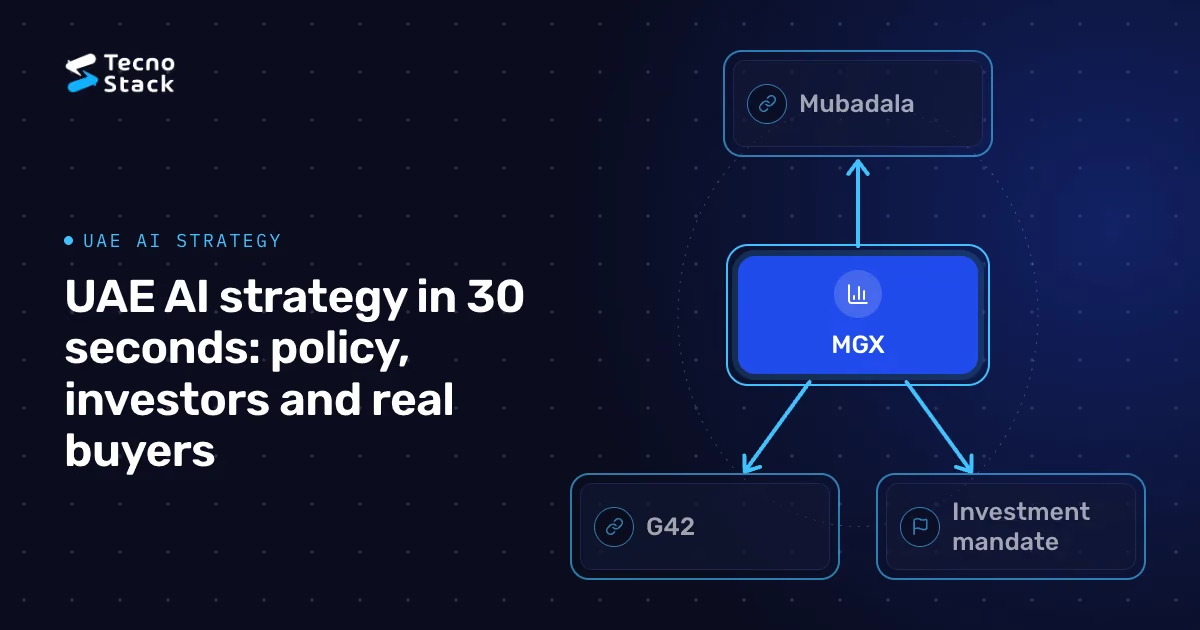
According to Mubadala's announcement, MGX was established in 2024 as a technology investment vehicle, with Mubadala and G42 as its founding partners. The March 2024 announcement describes investment areas spanning AI infrastructure, semiconductors, and AI technologies and applications. It describes G42 as an AI technology company working in cloud computing, data centers and applications. G42’s role as a founding partner is separate from the national policy document and from MGX’s investment decisions. Treat these as the announcement’s stated roles, and verify current mandates and services before outreach. That makes MGX an investor with its own mandate. It is not a ministry, a regulator or a grant program for startups.
If you are raising capital, approach any investor, MGX included, as an investor: with evidence of traction, a clear use of funds and an understanding of its mandate. Don't treat the existence of an investment vehicle as a sign that funding is available to your company, and do not assume its portfolio relationships guarantee introductions or purchasing access. This is general analysis, not investment advice.

Figure 1 — MGX invests in technology. Mubadala names its founding partners.
For most AI product and service companies, revenue comes from customers, not from strategies or investors. In practice, opportunities tend to arrive through:
- published tenders and requests for proposals from government entities and companies, through their own procurement portals and processes;
- enterprise AI programs inside banks, retailers, utilities and other organizations, with a named owner and a budget;
- partnerships with established technology vendors and integrators that need specialist capabilities;
- direct sales to organizations with a clear problem your product solves.
Each route has its own requirements for registration, security, data handling and references. Find out what they are before you invest in a bid.
Before committing time to an opportunity, answer these questions:
- Who is the buyer? A named organization, and a named person who owns the problem.
- Is there a budget and a decision process? Who approves the purchase, and how?
- What is the procurement route? Supplier registration, tender rules, evaluation criteria and timelines.
- What are the data requirements? Where data must be stored and processed, which personal data is involved and which security controls apply.
- What evidence will they ask for? Authorized references, relevant certifications, a proof of concept using permitted data or local presence. Verify which requirements actually apply rather than assuming all buyers require the same package.
- What would success look like? Measurable outcomes the buyer has agreed to.
If several answers are unknown, the opportunity is still unqualified, however promising it sounds.

Figure 2 — Check before bidding. Resolve unknowns before committing.
Expect enterprise and public-sector buyers to ask how an AI system is governed. Be ready to explain how you identify and manage risks, evaluate outputs, protect data and handle incidents. Frameworks help structure those answers; our guide to AI governance with the NIST AI RMF and the EU AI Act distinguishes the voluntary NIST framework from the EU AI Act, which is legislation with its own scope. Neither automatically supplies the applicable UAE obligations.
If you also serve customers in Saudi Arabia, data-protection rules differ by country, and our overview of Saudi PDPL and cloud data residency lists questions to raise with your legal team. Saudi Arabia's national AI actors are structured differently again; our article on HUMAIN, Saudi Arabia's PIF-owned AI company looks at one of them.
If you are planning how to bring AI into your organization or product, our AI transformation service can help you define use cases, governance and delivery.
- UAE Government. UAE National Strategy for Artificial Intelligence 2031: the national strategy document.
- Mubadala. Abu Dhabi launches comprehensive global investment strategy on artificial intelligence: the announcement establishing MGX, with Mubadala and G42 as founding partners.
This article is TecnoStack's general analysis, not legal, procurement or investment advice.