Hosting personal data in Saudi Arabia answers one question: where it is stored. Compliance with the Personal Data Protection Law (PDPL) depends on more than that, including a lawful basis and a defined purpose for each processing activity, respect for individuals' rights, adequate security, and how any transfer outside the Kingdom is handled. The law does not ban every overseas transfer: Article 29 deals with transfers, and the Saudi Data and Artificial Intelligence Authority (SDAIA) has issued a regulation that sets their conditions. The practical work is therefore to map your data flows and responsibilities, then have qualified counsel assess the actual processing. This article is a checklist for that mapping, not legal advice.
Teams often treat "the data is in a Saudi region" as the end of the conversation. It answers only the first of three questions:
- Residency: where the data is stored and processed.
- Lawful processing: the basis and purpose for each processing activity, what data is collected, how long it is kept, how individuals exercise their rights and how it is secured.
- Transfers: whether personal data, or access to it, leaves the Kingdom.
These are distinct but connected questions. A system hosted in the Kingdom can still involve a transfer, for example when a vendor's support engineers abroad can reach production data, or when logs are shipped to a monitoring service elsewhere. A system that processes some data abroad may be permissible if the applicable conditions are met. Neither situation can be judged from the hosting location alone.
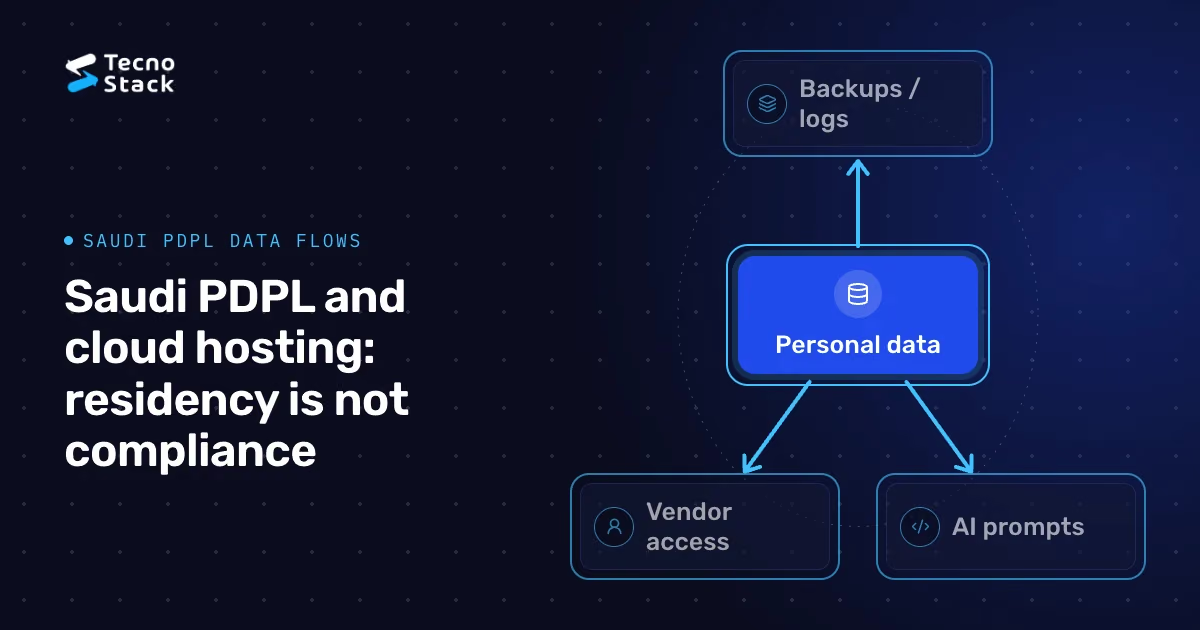
Personal data rarely stays in one place. Build an inventory that follows each flow from collection to deletion and includes the copies people forget:
- collection points: web forms, mobile apps, call centers and partner feeds;
- primary databases and file stores;
- backups and disaster-recovery copies;
- logs, monitoring and error-tracking tools;
- analytics, marketing, email and SMS services;
- support and ticketing systems;
- AI services, including prompts, retrieved passages and stored outputs;
- development and test environments holding copies of production data;
- remote administrative access by staff or vendors.
For each flow, record the categories of data, the purpose, where it is stored and processed, who can access it and from where, and how long it is kept. AI assistants deserve particular attention: a document assistant can place personal data in prompts and logs even if the source documents never move. Our enterprise RAG guide covers permission filtering and log handling for that case.

Figure 1 — Map every data flow. Include copies and remote access.
A map without owners decays quickly. For every processing activity, record:
- who in your organization decides its purpose and means, and who is accountable for it;
- which vendors process the data on your behalf, and which sub-processors they use;
- what the contract says about processing instructions, security, data location, sub-processor changes, incident notification to you and deletion at the end of the service;
- the internal owners: business owner, system owner and the privacy or legal contact.
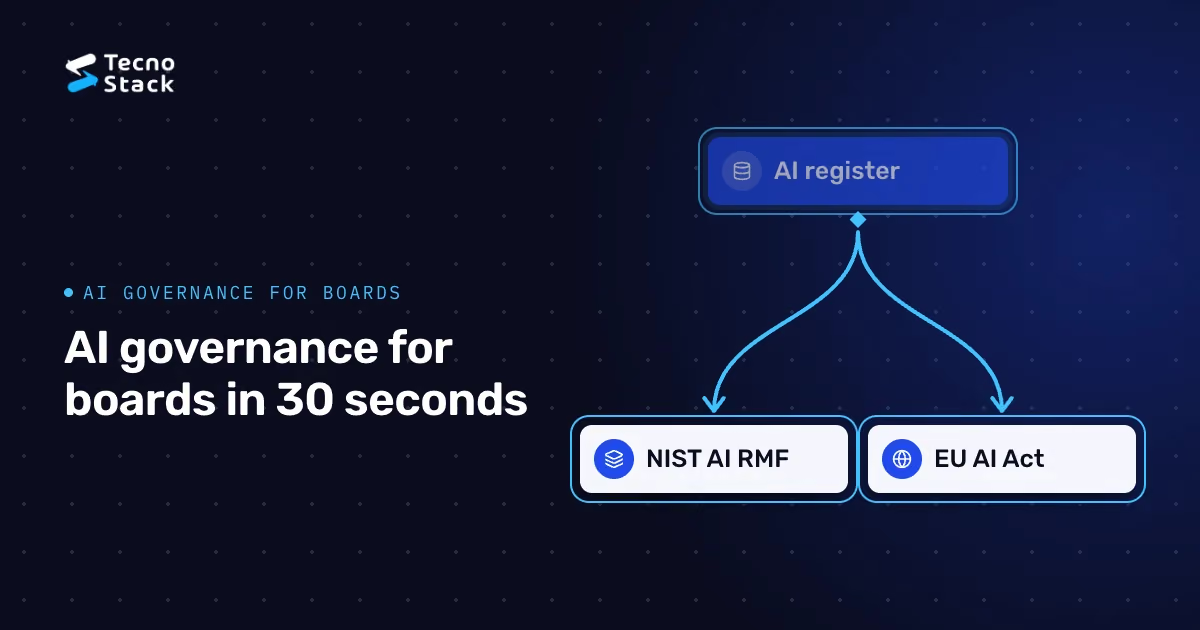
Ask counsel which roles and appointments the law and its implementing rules require of your organization, rather than assuming. Include any applicable sector-specific requirements in that assessment. Where AI systems are involved, connect this record to your AI inventory; our guide to AI governance with NIST and the EU AI Act explains how one register can serve several legal overlays.
From the map, list every flow that leaves the Kingdom, whether through storage, processing or remote access. For each one, record the purpose, destination, recipient, data categories, and the condition or basis your counsel relies on under SDAIA's transfer regulation. Then reduce what crosses the border: send only the fields that are needed, pseudonymize where possible, and keep direct identifiers in the Kingdom when the purpose allows. Pseudonymization is not automatically anonymization: if a person remains identifiable directly or indirectly, continue treating the information as personal data and assess the transfer conditions.
Revisit these decisions whenever a vendor changes regions, adds a sub-processor or changes its support model. Those changes can create a transfer without anyone on your team deploying anything.

Figure 2 — Assess before transferring. Document the purpose and safeguards.
Hosting in a Saudi region can reduce storage-related transfer questions for the data actually kept there and simplify the map. It does not settle whether you have a lawful basis, whether you collect more than the purpose needs, how long you retain data, how you answer individuals' requests or whether your security is adequate. Nor does it cover the flows around the hosting: global support access, third-party monitoring, email services or AI APIs that run elsewhere.
When choosing a provider, ask for written answers on where each service actually processes data, where support staff are located, which sub-processors are involved, and how backups and logs are handled. Then record those answers in the same data-flow map.
Data flows change with every new vendor, feature, AI tool or hosting region. Define change triggers that require a map update and a privacy review, and review the whole map on a regular schedule. Validate locations and access against configurations, contracts and operating evidence; a diagram alone does not establish compliance. A current map is also what lets you establish quickly, during an incident, which data and which people may be affected.
Organizations operating in several Gulf countries need the same discipline for each jurisdiction's rules. National strategies, such as the UAE's, set policy direction rather than data-handling obligations; our article on the UAE's AI strategy, MGX and G42 draws that distinction.
This checklist is TecnoStack's practical guidance, not legal advice; the legal assessment of your actual processing should come from qualified counsel. If you are planning hosting, backups, logging and access for systems that hold personal data, our VPS and cloud service can help you design infrastructure whose data locations are known and documented.
- Kingdom of Saudi Arabia. Personal Data Protection Law, official government copy; Article 29 addresses transfers of personal data outside the Kingdom.
- Saudi Data and Artificial Intelligence Authority. Personal data transfer regulation: the conditions for transferring personal data outside Saudi Arabia.