What did MENA startup funding look like in 2025? MAGNiTT's public summary of its FY2025 report gives a clear headline: venture funding grew 74% year on year to more than $3 billion, capital grew faster than deal activity, funding was concentrated in Saudi Arabia and the UAE, and international investors played a larger role at the growth and late stages.
That is what the free landing page says. The full report is a subscription product, and we have not reviewed it. So this article does not quote country shares, deal counts or sector splits. Instead, it explains what the public takeaways can and can't tell a founder, and how to plan a raise and runway around them.
From the public landing page of MAGNiTT's FY2025 State of Venture Capital in MENA report:
- Funding grew 74% year on year, to more than $3 billion in 2025.
- Capital scaled faster than activity: the amount invested rose faster than the number of deals.
- Funding was concentrated in Saudi Arabia and the UAE.
- International investors played a larger role at the growth and late stages.
These are MAGNiTT's takeaways, based on its own data and definitions. Other trackers count differently, for example in whether debt is included or how a company's country is assigned, so totals from different sources shouldn't be mixed or compared directly.
A regional total answers a regional question. It doesn't tell you:
- How your stage fared. If capital grew faster than deal count, much of the gain may sit in larger rounds. Early-stage founders need early-stage evidence, not the headline.
- How your sector fared. The public page names prominent sectors but does not provide the detailed distribution needed to assess your category. We have not checked the paid report's tables.
- Your odds. More money invested across the region doesn't mean more investors will meet you or that terms will be easier at your stage.
- What happens in 2026. A year-on-year increase describes 2025. It is not a forecast.
If a decision depends on figures beyond the public summary, buy the full report or ask the publisher, and cite exactly what you read.
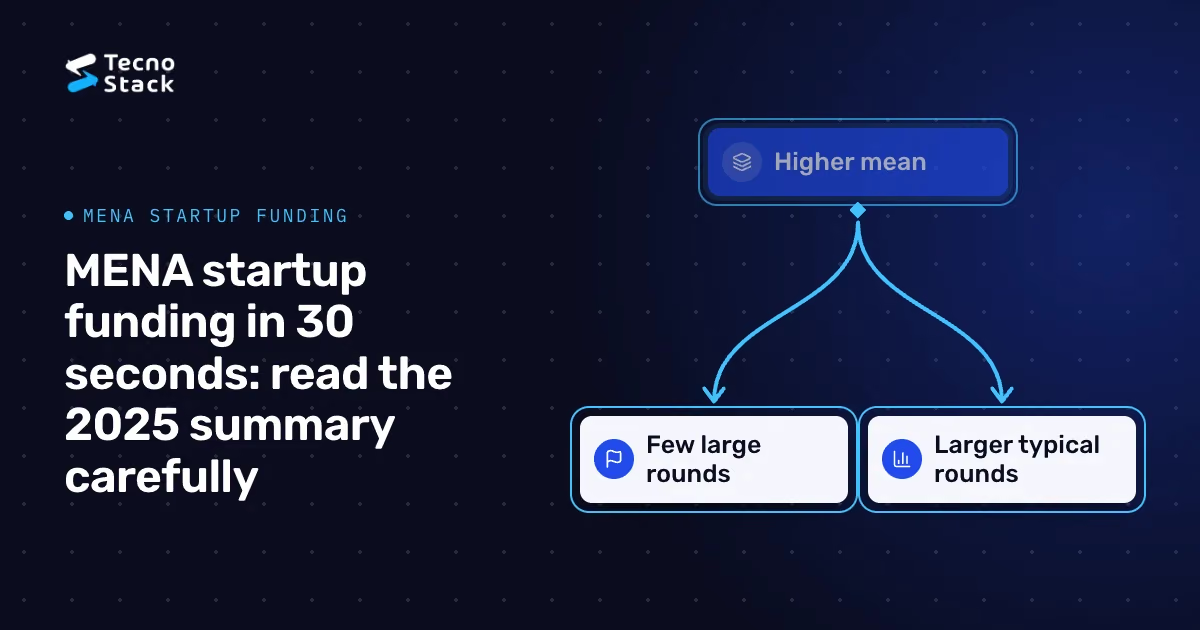
For a consistently defined set of rounds, total funding growing faster than deal count implies a larger arithmetic mean. That can happen because a few very large rounds closed, because typical rounds grew, or both. The public summary points to scale-stage momentum but does not quantify each contribution. The distinction matters: a handful of large late-stage rounds can lift a regional total while seed activity stays flat.
Single rounds can be large relative to a regional total. Outside the period this summary covers, Tabby announced a $233 million round at a $6.5 billion valuation in September 2026, according to the company, with the transaction still subject to regulatory approvals at announcement. A few completed rounds of that size in one year move totals considerably, which is why a headline figure says little about the typical startup. Our article on what Tabby's funding announcement does and doesn't prove looks at how to read individual rounds.

Figure 1 — Bigger averages can hide concentration. Both effects can coexist.
These are TecnoStack's practical readings, not findings from the report.
- Pre-seed and seed. Don't plan on the headline. Build a list of investors who have actually led rounds at your stage and in your category recently, using their own announcements and portfolios, and plan for a raise that may take longer than you hope.
- Series A. Investors commonly look for evidence that the product works with real customers and that growth isn't bought at any price. Clean metrics, cohort data and a credible milestone plan for the round matter more than market totals.
- Growth and late stage. The summary's point about international investors suggests more cross-border due diligence at this stage. Expect requests for audited financials, governance documents and detailed unit economics, and prepare a data room before you start.
Concentration in Saudi Arabia and the UAE describes where capital went, not where you must be. Where to base your company depends on your customers, licenses and team, and a regional total can't decide that for you.
Whatever the regional total, your company's survival depends on runway: the time your available cash can support operations. Available cash divided by positive monthly net cash burn gives a rough estimate, but a monthly cash-flow forecast should account for collections, debt, taxes and one-off costs. Exclude restricted cash and do not count unclosed funding as available. Model slower sales and a delayed raise as well as the expected case. Plan it around milestones rather than calendar dates:
- Name the milestone the next round needs, such as a retention level, a revenue run rate or a regulatory approval, in terms an investor at that stage would accept.
- Budget to reach it with a buffer for a slower raise, and decide in advance which costs you would cut first if the raise slips.
- Spend engineering money on the milestone. Build what proves it, and avoid infrastructure for scale you don't have yet; our guide to architecture decisions from MVP to scale explains which early choices are worth getting right.
- Choose delivery partners carefully. Rework is one of the quietest ways to burn runway. If you outsource development, our guide to choosing a software development company in the GCC covers the evidence, scope and handover terms to ask for.
- Review the plan monthly against actual burn and fundraising progress, not against the plan you raised on.
If you are planning a first release that has to fit a defined runway, our website design and development service can help you scope it around the milestone that matters.

Figure 2 — Plan for a delayed raise. Use available cash and net burn.
- MAGNiTT. FY2025 State of Venture Capital in MENA: public landing-page takeaways only. The full report is subscription-only and was not reviewed for this article.
- Tabby. Equity round announcement, 14 September 2026: $233 million at a $6.5 billion valuation, as announced by the company.
This article is TecnoStack's general analysis, not investment or financial advice.