How do you choose a software development company in the GCC? Judge it on evidence rather than its pitch. Ask to see relevant work and meet the people who will actually build your project, agree a scope that names deliverables and acceptance criteria, and settle handover and support terms before you sign. A polished proposal tells you how well a company sells. The questions below show how it delivers, who is accountable, and what you will own at the end.
Before you start, confirm that custom development is the right route; our nine questions for choosing between SaaS and custom software help with that decision.
Vendors can only be compared if they respond to the same brief. Keep it short and concrete:
- the problem, the users and the outcome you need;
- must-have features, with Arabic and English requirements stated explicitly;
- the systems to integrate with and the data involved, including personal data;
- constraints such as deadlines, budget range, hosting or regulatory needs;
- what you expect to own at the end: code, designs, documentation and accounts.
Ask every shortlisted company to state its assumptions in writing. Differences between proposals often come down to different assumptions about scope, and these are far easier to compare on paper than to discover mid-project.
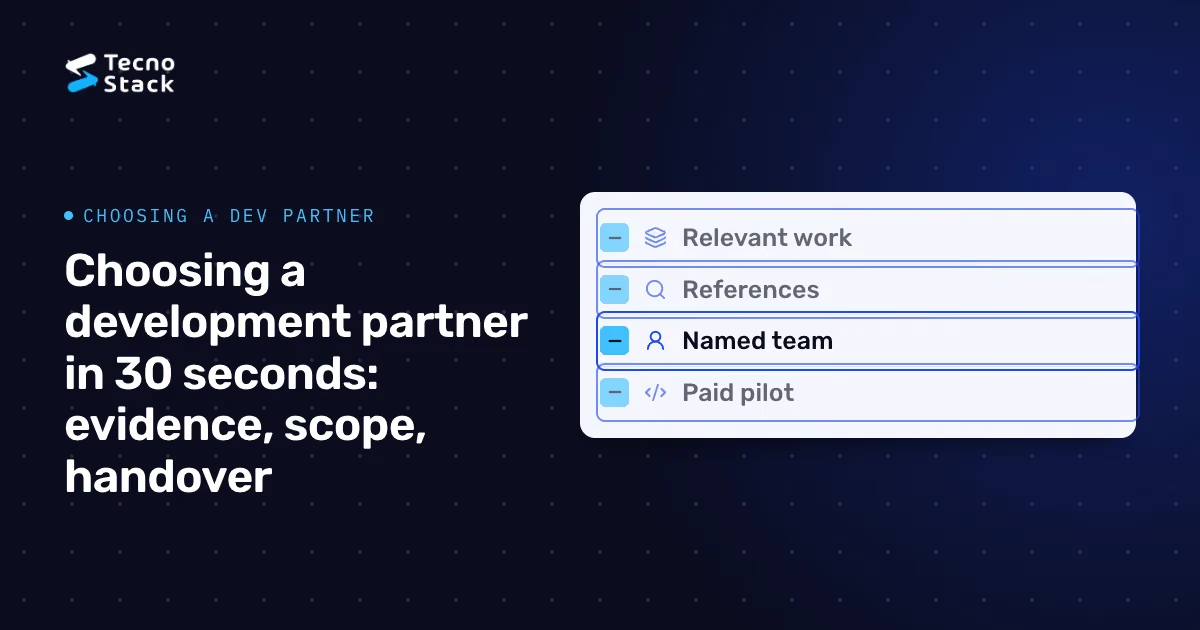
Any company can say it has deep expertise. Ask it to show you instead:
- Relevant work you can see: live products or detailed case material in a similar domain, with the company's actual role made clear. Use authorized or redacted material, without requesting another client's confidential information.
- References you choose: ask for several and call the ones closest to your project. Ask what went wrong and how the company responded, not only what went well.
- The named team: meet the people who would lead design, engineering and quality on your project, confirm their roles in writing, and agree what happens if someone leaves.
- How work is done: a sample of their documentation, how code is reviewed and tested, and how they handle security issues and incidents.
- A small paid piece of work: a short discovery phase or pilot on a representative problem, using synthetic or permitted minimized data, shows working style, communication and quality more reliably than any presentation.

Figure 1 — Meet the delivery team. Request authorized evidence of work.
A scope is accountable when both sides can tell whether it has been delivered. Write down:
- Deliverables and acceptance criteria: what "done" means for each feature, including both languages, accessibility and agreed performance checks.
- Milestones tied to working software you can review, rather than percentages of effort.
- Change control: how changes are requested, estimated, approved and recorded, and who has authority to approve them on each side.
- Roles and decisions: who on your side answers questions and signs off, and how quickly, because delays on the client side slow projects too.
- Risks and assumptions, reviewed at each milestone.
An unusually low quote deserves questions rather than suspicion: ask which assumptions make it low, and whether those assumptions match your brief.
Ask how the company would design, run and protect your system. The AWS Well-Architected Framework offers six useful areas for that conversation: operational excellence, security, reliability, performance efficiency, cost optimization and sustainability. These principles can inform other environments, while AWS-specific implementation guidance needs adaptation. A checklist helps structure review but cannot guarantee complete coverage. Our guide to architecture decisions from MVP to scale lists the early choices worth discussing in detail.
Accessibility needs the same attention. The W3C's WCAG 2.2 criteria cover keyboard access, text alternatives, visible focus and contrast. Ask how the company tests these in Arabic and English, including right-to-left layouts, and remember that an automated pass doesn't certify accessibility. If AI tools generate parts of the interface, human accessibility and Arabic review still apply, as our article on AI-assisted design systems explains.
You should be able to continue without the original company, whether by choice or necessity. Agree from the start:
- Ownership: agree ownership or continuing usage rights for commissioned code, designs and deliverables. Identify pre-existing tools, open-source components and third-party licenses separately; they may not transfer to you.
- Your accounts: source code repositories, cloud hosting, domains, analytics and third-party services live in accounts you control, with named, least-privilege access for the company. Test a build, deployment and recovery with the receiving team; revoke outgoing access and rotate affected credentials at transition.
- Documentation: an architecture overview, setup and deployment instructions, runbooks for common incidents and a record of key decisions.
- Knowledge transfer: sessions with your team or a new partner before the engagement ends, and a transition period written into the contract.

Figure 2 — Plan the handover. Agree rights and test the transition.
Launch is when support starts. Define it before you sign:
- support hours and response targets by severity, distinguished from restoration or resolution targets;
- who monitors the system and who is on call;
- maintenance scope and fees, including urgent security fixes, dependency upgrades and platform changes;
- a defect warranty period after launch, and how new requests are estimated and prioritized.
Write these into a service agreement with clear reporting, escalation contacts and exit terms for data export, retention and deletion, so both sides can see whether commitments are being met.
None of these proves a company is wrong for you, but each deserves a direct question: reluctance to work from a written brief, no access to the people who would do the work, vague answers about code ownership or accounts, no clear testing approach, or a quote without stated assumptions.
If you are choosing a partner for a website or web platform, we encourage you to assess us the same way; our website design and development service page is a starting point for that conversation.
- Amazon Web Services. AWS Well-Architected Framework: six pillars for reviewing a proposed architecture.
- W3C. WCAG 2.2 quick reference: accessibility success criteria, including keyboard access, text alternatives, focus and contrast.
This checklist is TecnoStack's general guidance, not legal advice; have contracts reviewed by qualified counsel.