HUMAIN is an artificial intelligence company owned by Saudi Arabia's Public Investment Fund (PIF) and launched in May 2025. PIF's portfolio page describes a scope that spans data centers, cloud and infrastructure, AI models and applications. That is a statement of remit and ambition, not a product catalog or a contract. If you are considering HUMAIN as a supplier, approach it as you would any strategic vendor: confirm what is available to you now, how it would integrate with your systems, which terms apply to your data, and how you would leave if you needed to.
Two primary sources anchor this guide. PIF's portfolio entry identifies HUMAIN as a PIF company launched in May 2025 and lists its intended scope across infrastructure, cloud, models and applications. HUMAIN's Hugging Face page publishes the model card for ALLaM-7B-Instruct-preview, a 7-billion-parameter Arabic and English model with a 4,096-token context and an Apache-2.0 license, which the card says was developed by the National Center for AI at SDAIA. It is one preview checkpoint, not a description of every ALLaM model or service.
Neither source tells a buyer which services are generally available, in which locations, at what price, under which service levels or with which certifications. Deal values and other figures that circulate in news coverage are outside this guide's verified sources, so they are not repeated here. Base procurement on current written evidence for the exact service, including tested capabilities, applicable documentation and contractual commitments.

Figure 1 — PIF describes four areas. Confirm the specific offering.
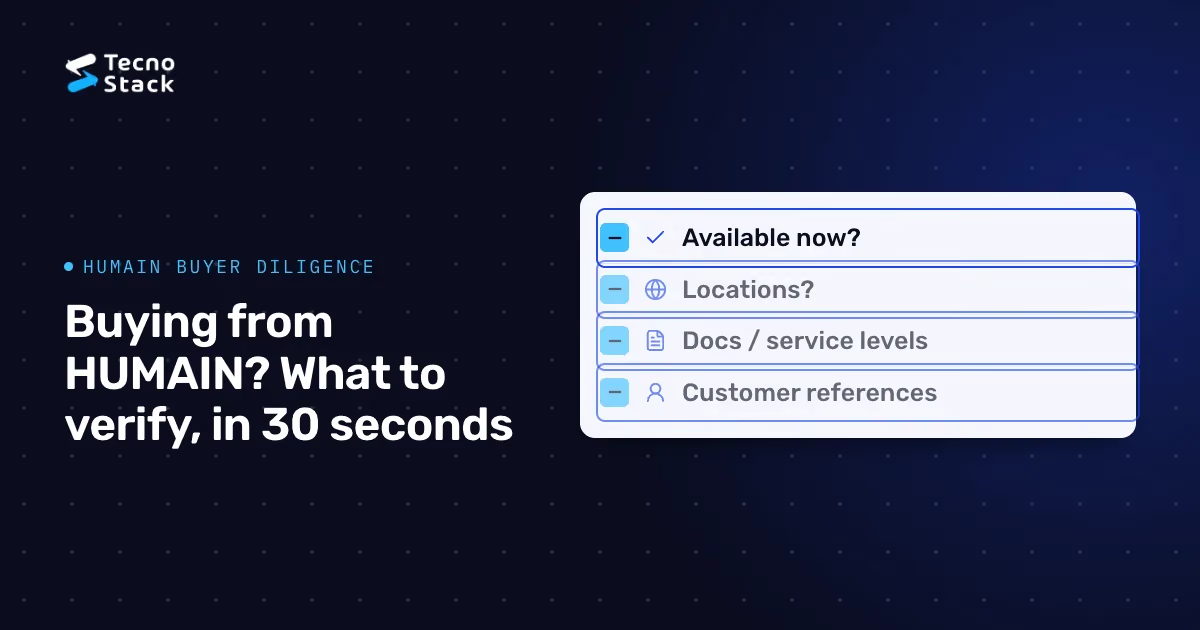
Start with your own needs rather than the company's ambitions. List the capabilities you are actually seeking: GPU capacity for training, managed inference for an Arabic-capable model, data center space or a sector application. For each one, ask:
- Is it generally available now, or planned? If planned, what is the committed date, and what happens if it slips?
- In which locations does it run, and can you choose?
- Is there public documentation, an API reference and a published service level?
- Can you speak to existing customers using the same service?
- Which parts of the offer are delivered by HUMAIN and which by partners, and who is accountable to you for each?
Do not plan a launch around an announced capability. Plan it around a service you have tested.
A server hosted in the Kingdom establishes that server's location; it does not establish where backups, telemetry, support access or other processing occur. Request written answers on where data is processed and stored, which sub-processors are involved, retention periods, whether your data may be used to train or improve models, access controls, incident notification and your audit rights. Ask for the security and compliance evidence that applies to your sector, and have it reviewed by people qualified to judge it.
Under Saudi Arabia's Personal Data Protection Law, lawful processing depends on more than the location of a server. Our PDPL data-flow and responsibility checklist sets out the questions to resolve before any personal data moves.
A capable platform still has to fit your systems. Engineers should confirm how authentication works with your identity provider, whether private network connectivity is available, how logs and usage data can be exported to your monitoring, how model versions are named and retired, and how much notice you get before a change. Ask about support hours, escalation paths and whether documentation is available in both Arabic and English.
Evaluate any model on offer exactly as you would any other candidate: on your own tasks and dialects, under comparable conditions, using permitted test data and native-speaker review. Our guide to comparing Arabic LLMs fairly explains the method. Practical limits matter too: a 4,096-token context, like the ALLaM preview checkpoint's, shapes how much retrieved text a prompt can carry.
Every supplier relationship should have a documented way out. Confirm the formats in which you can export your data, logs and any fine-tuned artifacts, what assistance is provided at termination, and how long data is retained afterwards. Where an open-weight model with a permissive license fits your needs, it can also be run elsewhere, which reduces lock-in; the Apache-2.0 license listed for the ALLaM preview checkpoint permits deployment elsewhere for that checkpoint, subject to its license obligations and the requirements of any supporting components. Confirm the license of whichever checkpoint you actually use.
On your side, keep prompts, retrieval and evaluation independent of any single provider, to reduce switching effort. A replacement may still require prompt, tool-schema and integration changes, data migration and full re-evaluation. For critical workloads, decide whether you need a second qualified option before the first contract renews.

Figure 2 — Plan your exit before signing. Test exports and replacement options.
A lower-risk starting point is a well-defined workload with success criteria agreed in advance, data cleared for the purpose and a comparison against at least one alternative. Measure accepted outputs, reliability and total cost against the baseline, review the contract terms the pilot exposed, and decide to widen, adjust or stop on the evidence. Record the decision and the reasons.
National AI programs across the Gulf share this dynamic. A strategy or an investment vehicle signals direction, but it does not create procurement commitments or guarantee access for any company; our article on the UAE's AI strategy, MGX and G42 draws the same distinction.
The questions in this guide are TecnoStack's practical guidance, not legal advice or HUMAIN requirements. If you are assessing sovereign AI suppliers as part of a wider program, our AI transformation service can help you structure the diligence, pilot and decision.
- Public Investment Fund. HUMAIN portfolio page: ownership, May 2025 launch and stated scope across data centers, cloud and infrastructure, models and applications.
- HUMAIN. ALLaM-7B-Instruct-preview model card: parameters, context length, languages, license and developer for this preview checkpoint.