Shopify Hydrogen and Medusa are often compared as if they were rival platforms, but they work at different layers. Hydrogen is Shopify's tooling for building a custom, headless storefront; the commerce backend, including products, checkout, orders and payments, stays on Shopify. Medusa provides modular commerce building blocks with self-hosted or managed deployment; your team still owns application customization and integration decisions. The real decision is who runs commerce and how much of it you need to change. Whichever you choose, local payments, refunds and invoicing have to be specified and tested, and neither stack establishes tax compliance on its own.
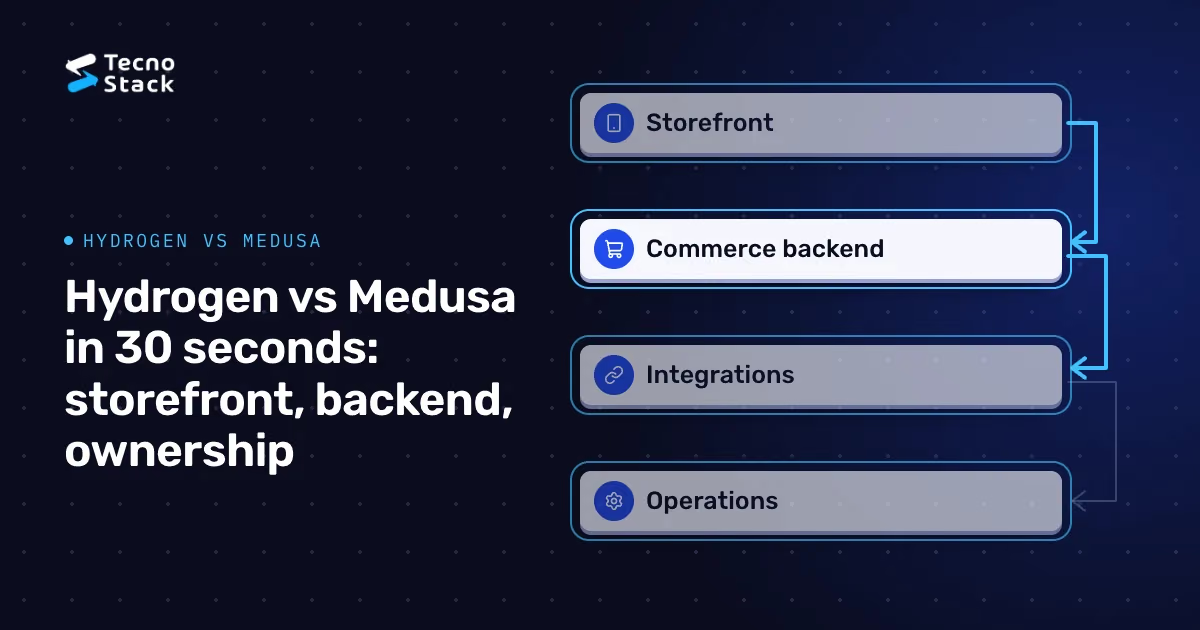
A headless commerce system has at least four layers, and it helps to name them before comparing tools:
- Storefront: the pages and interactions customers see, in Arabic and English.
- Commerce backend: catalog, pricing, promotions, cart, checkout, orders, payments, returns and tax calculation.
- Integrations: payment providers, shipping carriers, ERP or accounting, e-invoicing, marketing and support tools.
- Operations: hosting, monitoring, security updates, incident response and the changes you make every month.
"Headless" only means the storefront is separated from the backend. It doesn't say who owns the other three layers, which is where the two options differ most.

Figure 1 — Name each layer. Assign an owner to each.
Shopify's documentation presents Hydrogen as its tooling for building headless storefronts. You design and build the customer-facing experience yourself, while Shopify remains the commerce backend: products, inventory, checkout, orders and the admin your team uses.
That split has practical consequences:
- You own the storefront code: its performance, accessibility, Arabic layout and the hosting it runs on.
- Shopify owns most commerce operations: you configure them, but you don't run the servers behind checkout and orders.
- Your options are bounded by Shopify's platform: the APIs, checkout options, apps and payment providers available to your store and country. Confirm those for your business rather than assuming them from marketing material.
Hydrogen makes most sense when the storefront experience is your differentiator and Shopify's commerce model fits your business.
Medusa's documentation describes modular commerce building blocks: modules for products, carts, orders, payments and more that you assemble, extend and connect to other systems. Choose the deployment separately from the framework. Medusa's deployment documentation describes both self-hosting and Medusa Cloud, its managed infrastructure offering. The hosting arrangement changes infrastructure responsibilities, while application configuration and integration work still need named owners.
That brings freedom and work in equal measure:
- You can change the commerce logic itself, such as pricing rules, order flows, multi-store setups or unusual fulfillment, not just the storefront.
- Self-hosting adds infrastructure work: hosting, database, backups, monitoring, upgrades, security patches and on-call response. Managed hosting can take on agreed parts; verify the scope rather than assuming every operational duty transfers.
- Every integration is yours to build or select, including payments, refunds, shipping and invoicing, and to keep working as providers change.
Medusa makes most sense when your commerce logic genuinely differs from what hosted platforms model, and you have the engineering capacity to run it for years.
Before choosing, write down responsibilities for the life of the store, noting who handles each item in each option:
- Storefront code and hosting: your team owns implementation; hosting responsibilities depend on the chosen service.
- Checkout, orders, and the backend's uptime and security: Shopify runs its platform with Hydrogen, while your configuration remains your responsibility; Medusa responsibilities split between your team and the selected hosting provider.
- Payment, shipping and invoicing integrations: apps or your team with Hydrogen, within what Shopify supports; your team with Medusa.
- Upgrades: the storefront framework with Hydrogen; your application and integrations with Medusa, plus infrastructure components not covered by a managed service.
- Incidents: shared with Shopify's status updates and support for Hydrogen; shared with your hosting and integration providers for Medusa, with your team coordinating application incidents.
Agree who covers each item at night and on weekends. The option that looks cheapest on paper can become the most expensive once you staff its operations.
Whatever the architecture, a Gulf store succeeds or fails on local details. Validate each of these for every target country:
- Payments: confirm with each provider which methods it supports for your business and country, then test successful payments, declines, authentication challenges and partial refunds end to end.
- Refunds and returns: check that refunds reach the original payment method, including pay-later plans, and that stock and accounting update correctly.
- Arabic and right-to-left: test checkout forms, address and phone formats, error messages and emails in Arabic.
- E-invoicing: in Saudi Arabia, the Zakat, Tax and Customs Authority (ZATCA) runs an e-invoicing program with a generation phase and an integration phase, with the integration phase applied to notified taxpayer groups in waves. Whether and how it applies to you is a question for ZATCA's guidance and your tax adviser. The storefront choice doesn't determine invoice compliance: decide which system issues invoices, whether the commerce backend, an ERP or accounting software, and test that integration end to end.
Use a prototype or sandbox before committing, then run controlled production checks for credentials, webhooks, settlement and invoice reporting before the full launch; sandbox success alone does not prove production readiness.

Figure 2 — Test local integrations. Compliance requires its own assessment.
- Choose Hydrogen when a custom storefront is your differentiator, Shopify's commerce model and available integrations fit your business and country, and you want Shopify to run the backend.
- Choose Medusa when your commerce logic needs to change in ways hosted platforms don't support, and you can staff the operations for the life of the store.
- Consider neither if a standard theme on a hosted platform would serve your customers well: a headless build adds work you should take on only for a reason.
Whichever you choose, the content model and the performance budget matter as much as the backend. Our guide to designing headless CMS content models covers which system owns product content, and our guide to Core Web Vitals covers keeping a headless storefront fast. To judge whether the store will pay for itself, start with the per-order view in our guide to evaluating GCC e-commerce. If you want help planning the build, our headless e-commerce service designs the storefront, backend and integrations together.
- Shopify. Hydrogen: Shopify's tooling for headless storefronts on Shopify's commerce backend.
- Medusa. Medusa documentation: modular commerce building blocks and the integrations a team builds on them.
- Zakat, Tax and Customs Authority (ZATCA). E-Invoicing: preparing for the integration phase and its implementation waves.
Platform capabilities, payment options and tax obligations change and vary by country, so confirm them with providers, ZATCA and your advisers. The recommendations here are TecnoStack's guidance, not vendor requirements or tax advice.