
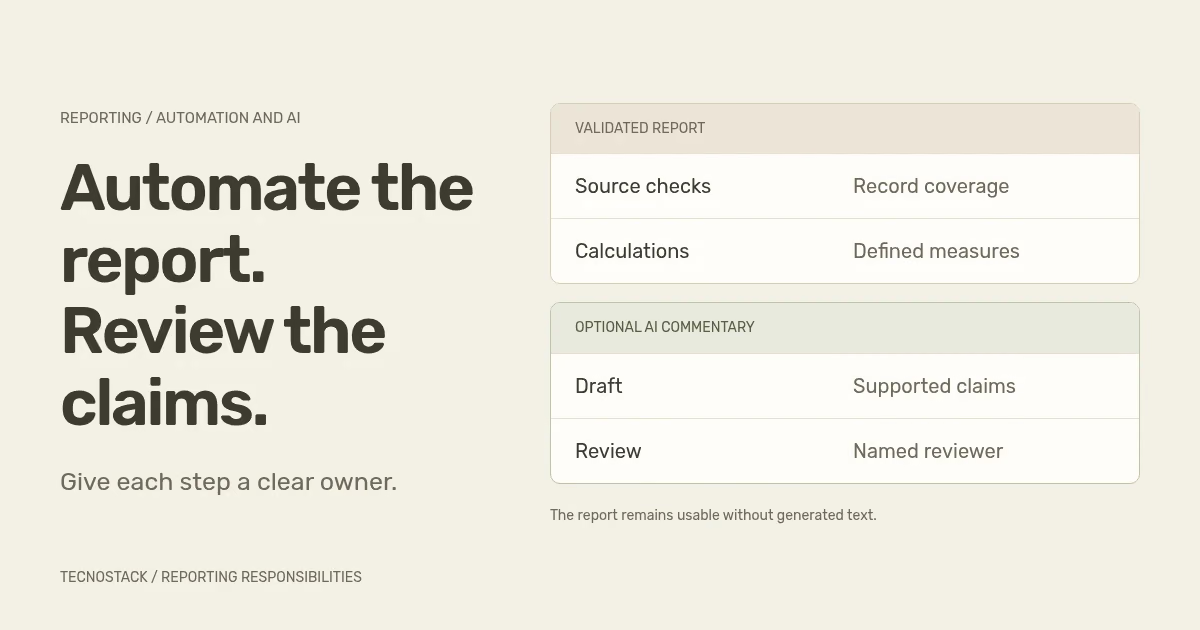
Automate the repeatable parts of reporting first: retrieve authorised data, apply agreed calculations, check the result and deliver the permitted view. Add generative AI when a language task, such as drafting a summary or answering a question, has a clear benefit and a way to verify the answer. A scheduled dashboard and an AI explanation solve different parts of the work.
Start with one recurring report and the decision it supports. If the team cannot agree what its main number means, use the dashboard brief before choosing an AI feature. Generated prose will not resolve an unapproved definition merely by making it sound settled.
Observe a complete reporting cycle. Separate time spent extracting records, reconciling sources, calculating measures, formatting views, writing commentary and distributing the result. A request to “use AI for reports” may turn out to be a broken export, a repeated spreadsheet formula or an unclear approval step.
Use this original task worksheet to choose the first implementation. The methods can coexist; the point is to give each one a defined responsibility and acceptance test. Confirm that the selected platform and edition support the proposed behaviour.
| Reporting task | A method to assess | What should prove it works? |
|---|---|---|
| Retrieve approved source records | Supported connector or scheduled extraction | Expected records arrive with a visible update state |
| Calculate a defined KPI | Tested query, measure or transformation | Records and totals reconcile under agreed filters |
| Send the same permitted report | Scheduled distribution or subscription | Correct recipients receive the right view and period |
| Flag an agreed threshold | Explicit rule with an owner | Boundary values, missing data and repeated alerts behave correctly |
| Draft commentary or answer a language question | Generative AI over approved context | Claims, calculations, sources and access withstand review |
| Predict a future value | A separately validated forecasting approach | Evaluation uses suitable historical holdouts and a meaningful baseline |
A fixed sentence template can also report a defined change without a language model. Forecasting is a separate analytical task, and a fluent paragraph about next month is not evidence of predictive accuracy. Forecasting: Principles and Practice explains evaluation using observations that were unavailable when a forecast was made. Scope those needs explicitly rather than bundling every form of analysis into an “AI dashboard”.
Document the source, record grain, formula, exclusions, reporting period and owner for each important measure. Keep the calculation in a maintained, testable reporting layer. If an AI tool generates a query, verify the query and its result before relying on it; generating code does not approve the business definition.
Microsoft's Copilot responsible-use guidance advises reviewing generated DAX queries before applying them. The same practical distinction applies to a reporting project: a proposed query is a work product to inspect, while an accepted metric needs evidence from the actual records and rules.
Resolve missing values and repeated joins before drafting the summary. The data-quality checklist shows how four orders can produce a misleading total after a shipment join. An AI summary that accurately repeats that inflated number would still mislead its reader.
Define freshness separately from language quality. Microsoft's scheduled-refresh guidance covers the underlying refresh setup, credentials and gateways. A well-written daily email can describe stale data if the source or refresh failed. Carry the reporting cutoff and update status into any generated narrative.
Generative AI can help draft text or translate a user's question into a proposed analysis. It also introduces the possibility of confident unsupported statements. NIST's Generative AI Profile, section 2.2, describes this risk as confabulation. Fluency and confidence are not substitutes for evidence.
Give the system the approved definitions, relevant fields and examples of acceptable answers. Microsoft's Prep data for AI guidance, currently labelled Preview, describes AI data schemas, verified answers and instructions for Copilot. It also states that preparation cannot ensure a particular output every time because behaviour is nondeterministic.
Treat these tools as ways to improve context and testability. An “approved” model label is not proof that every possible response is correct. Evaluate the questions people will ask, the evidence available for each answer and the behaviour when the evidence is absent. Confirm current feature availability for the proposed environment before including it in a delivery scope.
Consider an invented example, not a client result. Two complete weekly order cohorts use the same definition and currency. The prior week's recorded order amount is 1,000 SAR and the current week's is 950 SAR. These are order amounts, not recognised revenue or collected cash. The comparison is descriptive, with both periods closed at their agreed cutoffs.
The arithmetic is (950 - 1000) / 1000 = -5%. A supported summary says: “Recorded order amount was 950 SAR for the current week, 5% below the previous week's 1,000 SAR, using the agreed order definition.” Retain the period, source and definition reference with that statement.
Now suppose a draft adds: “Late deliveries caused the decline.” The two totals contain no evidence establishing that cause. The reviewer should remove the claim or turn it into an explicitly untested investigation question, with the additional evidence needed to assess it. Do not convert a plausible business story into a reported finding.
If the current source is incomplete, the comparison needs different treatment. The system should flag the gap according to the reporting rule, rather than confidently describe a 5% decline as if the periods were comparable. Missing data is a test case, not an invitation for the model to fill in the story.
Build a small reviewed set of questions and expected behaviours before the pilot. Include ordinary requests, ambiguous questions and failures. The original matrix below is a starting point, not a universal certification or a guarantee about a product.
| Test case | Expected behaviour | Evidence to retain |
|---|---|---|
| Known calculation and period | Returns the approved result with its scope | Source snapshot, query or measure, and answer |
| Ambiguous term such as “sales” | Clarifies the definition or states the approved meaning | Question, selected definition and reviewer decision |
| Missing or stale source | Discloses the limitation and follows the failure rule | Update state and visible response |
| Unsupported causal question | Separates observed change from an untested explanation | Claim review and required follow-up evidence |
| User without access to a dataset | Does not reveal restricted records or aggregates | Actual role, request and access-test result |
| Arabic and English versions | Preserve metric, dates, units and intended meaning | Paired questions and bilingual review |
| Changed data or model definition | Repeats relevant checks before the changed output is used | Version record, test results and approval owner |
Do not test only with the developer's broad account. Verify actual authorisation independently of the text instructions given to AI. Review what data the chosen feature receives, how output is shared and the current vendor terms for the intended environment. A smaller prompt or schema is not a replacement for data-access controls.
Compare the entire task with the current process. Include data preparation, review time, corrections, failed runs, user effort and operating cost. Define a useful result in advance: a reviewer can confirm the relevant facts and complete the decision task with fewer avoidable steps. Keep observed pilot results separate from promised future savings.
Start with a bounded audience and named review responsibility. Keep a way to use the validated report when generated commentary is unavailable or fails review. Record who changes the definitions, monitors failures, renews access and checks a new model or feature version.
Use the Power BI and Data Studio comparison for platform ownership and sharing questions. Bring the recurring report, current manual steps and intended audience to our business dashboards and reporting service. We can scope ordinary reporting and any optional generated analysis separately, after checking existing service inclusions.


