
Choose between managed hosting and DevOps work by identifying the responsibility that is missing. Hosting usually centres on the environment and its agreed care; a release-process engagement centres on how application changes are built, checked, deployed and recovered. Their scopes can overlap substantially. Start with the existing agreement before adding another service.
A team that cannot restore its website needs a different conversation from a team whose deployments depend on one developer's laptop. Another team may already have a pipeline but no clear owner for a failed background job. Describe the actual incident or blocked task first, then decide which operating responsibility needs attention.
“Managed” does not specify every task, support hour or recovery commitment. A provider may manage a virtual machine, a website platform or a wider application environment. The application team may still own business logic, data definitions and release acceptance. The word alone cannot tell you who will investigate a failed booking.
The underlying cloud service also changes the division of work. The AWS shared-responsibility model distinguishes responsibilities according to the services selected. Managing a guest operating system on a virtual machine differs from using a service where the provider operates that layer. A separate support agreement then needs to identify which customer-side tasks your service partner performs.
Microsoft's shared-responsibility guidance likewise distinguishes infrastructure, platform and software services while retaining customer responsibilities for data, identities and configuration. These frameworks explain why responsibilities differ; they do not replace the terms of your hosting or application agreement.
DevOps is also broader than installing a pipeline. DORA's continuous-delivery guidance connects delivery capability to testing, deployment, architecture and collaboration. For a buyer, the useful question is which part of that work an engagement will deliver and who will operate it afterwards. A tool list is not an acceptance plan.
Read the current service page and proposal together. TecnoStack's managed website hosting describes backups, test restores, staging work and maintenance within the selected plan's conditions. It includes a documented rollback path; automatic rollback is not promised. Mailboxes and application development are separate from that hosting scope.
The VPS and managed cloud service already describes infrastructure as code, deployment workflows, monitoring and recovery runbooks in its agreed deliverables. Published plans have defined resources and management time. High availability and round-the-clock response are separately quoted, and the managed label does not imply an availability SLA.
The Connected Product mobile scope includes a release pipeline, separate test and live environments and its stated acceptance-test plan. Existing app release and handover inclusions remain in place. A request for these delivered capabilities should first be checked against the application agreement.
Those examples matter when assessing the new DevOps and release-automation service. The purpose of a separate engagement is to define additional work where required, such as another application, a missing integration check or a wider recovery rehearsal. It should not reclassify an existing inclusion as an extra purchase.
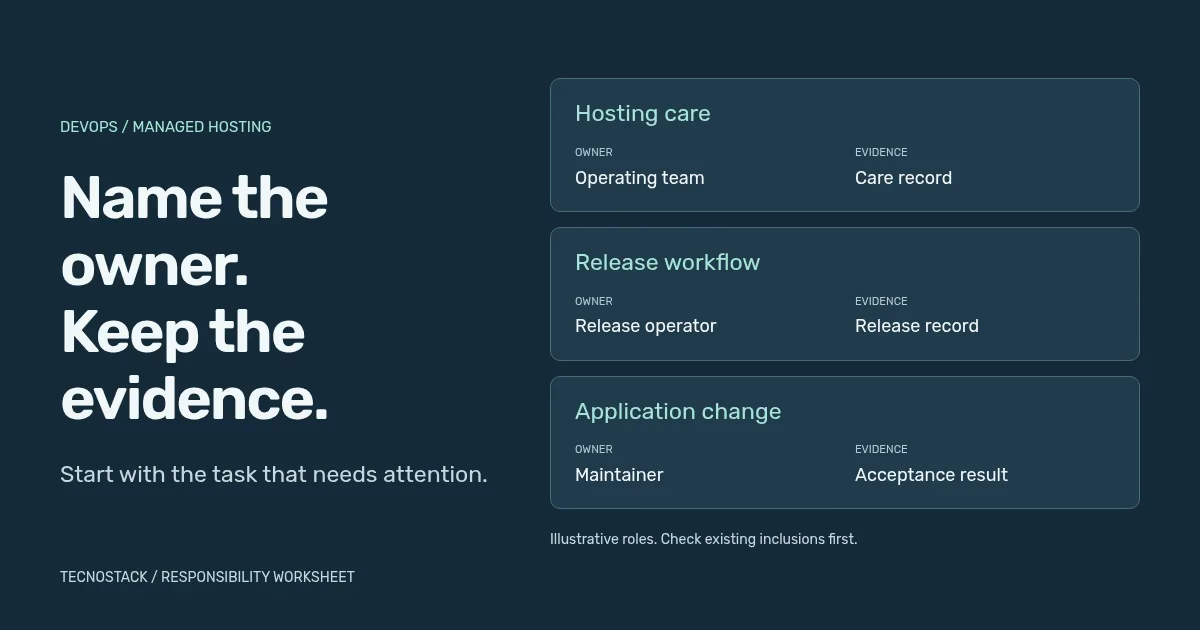
Take one recent release or incident and fill in the original worksheet below. Replace general labels such as “the provider” with an actual team and named contact. If two parties share a task, state where the handoff occurs and who makes the final decision.
| Task | Ownership question | Evidence to request |
|---|---|---|
| Hosting resources | Who provisions and changes the agreed capacity? | Resource inventory and change authority |
| Updates and patches | Which infrastructure, runtime and application layers are covered? | Scope, schedule and completed-change record |
| Release workflow | Who maintains the build, checks and deployment steps? | Versioned workflow and a repeatable release record |
| Production decision | Who can authorise this candidate for this environment? | Agreed rule, access and decision record |
| Data and recovery | Who checks backups, restores and version compatibility? | Restore evidence and release-specific recovery plan |
| User-flow failure | Who distinguishes hosting failure from application failure? | Diagnostic route and relevant acceptance checks |
| Alerts and incidents | Who receives the signal and acts during which hours? | Recipient, cover, escalation and response terms |
| Accounts and exit | Who controls access, billing and transfer? | Ownership register and practical handover |
Look for both gaps and duplication. If the cloud engagement already supplies the deployment workflow, ask whether it meets the application's current acceptance needs. A newly added worker may require an extension; an undocumented workflow may need a handover correction. Neither case automatically requires replacing the whole hosting arrangement.
The following scenarios are illustrative decisions, not package recommendations based only on company size. Each starts with a task and the existing scope that should be checked. Confirm the actual platform and agreement before choosing additional work.
| Situation | First review | Possible next scope |
|---|---|---|
| A WordPress update needs a staging check | Current hosting plan, supported staging and maintenance allowance | Use the inclusion; quote only work outside the agreed boundary |
| A custom app release depends on manual commands | Existing cloud deployment workflow and application handover | Document or extend the bounded release process |
| A delivered mobile product needs its promised pipeline | Connected Product deliverables and acceptance record | Complete or review the included handover before buying another pipeline |
| Alerts arrive when nobody is responsible for responding | Support hours, recipients, escalation and business need | Explicit response coverage, rather than an inferred monitoring promise |
For example, imagine an application whose hosting partner already operates the server and release workflow. A new background worker now requires a separate deployment step and a retry test. A useful brief names that worker, its queue, the release sequence and the expected failure behaviour. It asks whether the extension fits the existing scope before commissioning additional implementation.
If the worker cannot safely consume records from the previous version, the issue may require application design work. A larger server or a different pipeline tool will not resolve the compatibility decision alone. The rollback guide shows how to define the return path around the data that actually exists.
Compare the same work. Separate infrastructure usage, licences and third-party services from setup, migration, ongoing management and application changes. Record the environments, repositories and integrations covered. A proposal with more tools but no operating owner may leave the original problem unresolved.
Ask what uses an allowance, what happens when it is exhausted and which requests need separate scoping. Confirm support hours, planned maintenance and incident escalation. An initial implementation fee and an ongoing operating agreement cover different periods and responsibilities; neither should silently imply unlimited future changes.
Review recovery in the same way. A backup schedule, a successful restore rehearsal and a recovery-time commitment are different facts. Ask for the scope and evidence relevant to your application. Avoid comparing a documented procedure with a guaranteed response as if they were equivalent deliverables.
The appropriate maintainer should be able to identify the deployed version, locate the release evidence, follow the agreed access process and explain what happens when a check fails. The CI/CD worksheet makes these requirements concrete. Account ownership and operating knowledge both belong in the handover.
Also verify the environment boundary. The staging and production guide covers data, credentials, integrations and background jobs. If a test environment can still write to live records, a polished deployment dashboard has not resolved that operating gap.
Prepare one page describing the application, current hosting agreement, last difficult release and the people responsible today. Use it to review the missing release responsibility. The resulting scope should say what changes, what evidence will establish acceptance and who maintains it afterwards, while preserving the work your existing service already includes.


