n8n vs Zapier is a decision about your workflow, its operating owner and its usage costs. Test the same business request in both tools before choosing: receive an enquiry, match its CRM record and notify the responsible person. Select the setup your team can operate, with evidence for the integrations and recovery steps you need.
For a Saudi business, the comparison should include Arabic data, connected local systems and the person who handles a failed run. This guide uses an illustrative sales request, REQ-A, rather than a customer case study. We checked official documentation on 30 October 2026; platform details below are stated as of October 2026 and need another check when you purchase.
Start a Zapier trial when your operations team can assemble the required process with the apps and events available in its account. Include n8n when you need to evaluate self-hosting or an operating arrangement with a technical owner. Treat these as starting hypotheses and ask each supplier to demonstrate the same workflow before accepting a recommendation.
As of October 2026, n8n’s deployment options include its managed Cloud service and self-hosting, with features depending on the plan or edition. Compare Zapier, n8n Cloud and self-hosted n8n as distinct operating arrangements. Naming a product does not specify who maintains the infrastructure or which account permissions your staff receive.
| Decision criterion | Check in n8n | Check in Zapier |
|---|---|---|
| App connection | Required nodes and fields in the chosen edition | Required trigger and action in your account |
| Operating owner | Workflow owner and, if self-hosted, infrastructure owner | Workflow, account and subscription owner |
| Usage | Executions and the selected plan’s rules | Chargeable actions and exceptions |
| Acceptance | Evidence from your sample and failure cases | The same evidence from the same sample |
| Supplier exit | Agreed files, documentation and account access | Account ownership and documented configuration |
Ask the employee who will operate the workflow to make a small test change, such as replacing a notification recipient. Watch whether they can locate the setting, restore it and identify who to call after a failure. Record that handover exercise beside the integration results and cost assumptions.
Choose a process with a clear starting event and a result your staff can inspect. Our hypothetical request, REQ-A, arrives from a sales form, requires a CRM lookup and leads to a notification for its owner. The identifier is illustrative; it describes no real client or measured TecnoStack outcome.
Write acceptance criteria before building: preserve the Arabic name, retain the request identifier and address the notification to the authorised recipient. Add a missing phone number, a duplicate request and a delayed CRM response. Give each case an expected outcome, such as holding incomplete data for review instead of inventing a value.
As of October 2026, Zapier’s definition of a Zap describes a trigger followed by actions, with fields mapped between steps. Check which event your implementation uses. Creating a new record and updating an existing record are different business situations; your brief should say which starts the process.
Use our guide to selecting a repeated task for automation if the first workflow remains undecided. Keep requests from other departments in a later-work list. Asking suppliers to automate the entire sales process at once makes their proposals harder to compare because each may assume different boundaries.
Separate the implementation fee from the operating budget. Ask for distinct lines covering process mapping, connections and acceptance testing, followed by subscriptions, infrastructure, support and external provider usage. Use request counts from your own records and identify periods where you lack data. A single unsupported forecast gives you a weak basis for choosing a plan.
As of October 2026, n8n’s plan page bases its plans on workflow executions. Zapier’s task accounting counts successful actions, with exceptions and different rates for some tools; triggers, Filter and Paths do not count as tasks. Review the applicable rule for each step instead of multiplying diagram boxes by requests.
In the illustration, a workflow run spans Request, CRM and Notify, while actions sit inside that run. Ask the implementer to run the sample and inspect actual usage with you. Record what the plan covers and which connected services charge separately. The diagram explains units; it neither calculates your invoice nor establishes a cheaper platform.
Request estimates for a normal period and a busier period, each with explicit assumptions. Include recovery work and repeated processing. Confirm currency, billing period and applicable taxes in the provider’s purchasing terms. We have not converted foreign subscription prices into a Saudi quotation or assumed a saving your test has yet to demonstrate.
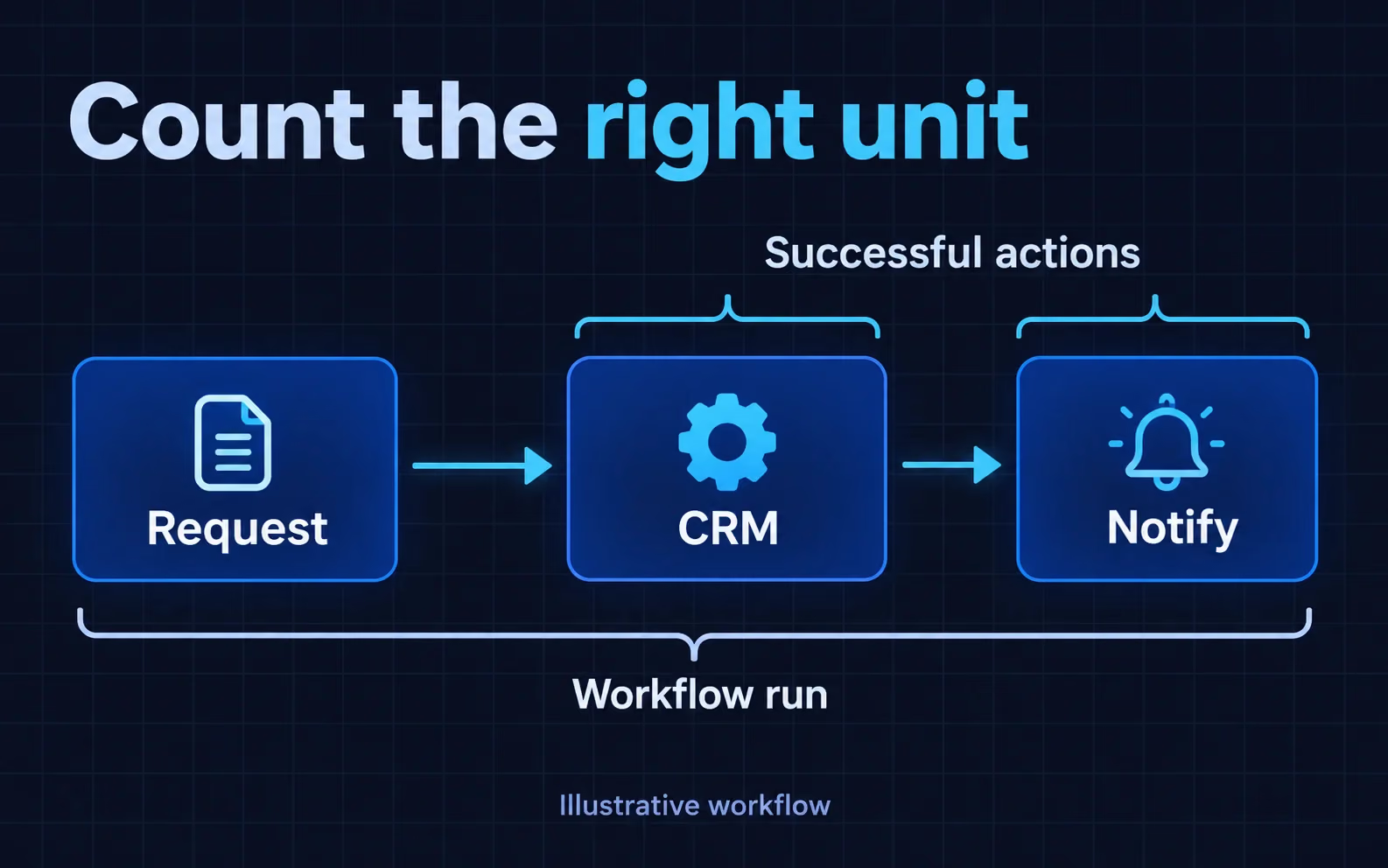
Illustrative workflow: distinguish the complete run from individual actions. Check each step against the plan rules; this is not an invoice or evidence that one tool costs less.
Choose self-hosting when you can name the people responsible for updates, backups and restoration. As of October 2026, n8n’s hosting documentation describes running it on your infrastructure or in a private cloud, with different editions. Specify the edition and management scope in the proposal before treating self-hosting as a complete operating plan.
Agree who monitors failures, tests updates and rotates credentials when an employee leaves. Record who owns the cloud account and receives alerts outside normal working hours. Restore a test record from a backup during acceptance. A file labelled “backup” gives you little evidence about who can restore it or how the procedure works.
Map the data destinations, including the CRM, email service and any AI provider. Ask your data owner to review those destinations and permissions before using real records. Hosting the workflow engine addresses one part of that map; review the connected services against your organisation’s requirements as separate decisions.
For a cloud service, assign ownership of accounts, connections and workflow testing. Our guide to separating application operations from hosting helps define that boundary. Ask for a written escalation route: who investigates first, who contacts the provider and how employees continue the task while the incident remains open.
Verify the event, fields and permissions your workflow needs, then test them with a suitable account. Ask the supplier to demonstrate the actual operation: reading an order, finding a customer or changing a specific status. Treat an app name in an integration directory as a reason to inspect the supported operations before agreeing the scope.
Prepare a field map showing source, destination and transformation rule. Test an Arabic name, a phone number with country code and the date employees see in Saudi Arabia. Define the handling of empty values and statuses the receiving system does not recognise. If you need a custom API connection, specify its build, maintenance and source-code handover separately.
Decide which system owns each value before synchronising records. Our guide to assigning field ownership across CRM and ERP covers that decision. Also request a record of the identifiers in both systems, so a support employee can trace a request without relying on the customer’s name alone.
Include a revoked or expired connection in the test. Check the alert and the process for renewing access without placing keys in handover screenshots. If API access requires a paid account with your existing provider, obtain that provider’s confirmation before agreeing the implementation price and date.
Design recovery around the work that has already completed. In our hypothetical example, the workflow saves REQ-A in the CRM and then fails to send its notification. Ask for a rule that checks the identifier on retry, reuses the existing record and handles the outstanding notification. Test that replaying the request creates no second record.
As of October 2026, n8n’s error-handling documentation describes an error workflow starting with Error Trigger, which can send alerts after an execution failure. Zapier’s history documentation describes reviewing runs and usage to investigate problems. Inspect the configuration your supplier delivers and the evidence your operator sees when something fails.
Write a recovery procedure that identifies the affected request, the last completed step and the person allowed to retry it. Include a case where the destination accepts a request but its response is delayed. Inspect the destination before another write; hold the request for review when you cannot establish what happened.
During handover, have your employee follow the procedure with test data. Cover a held request, a corrected field and the final record of the intervention. These are proposed acceptance checks. They do not imply that either platform’s default template prevents duplicates or recovers your particular integration without configuration and testing.
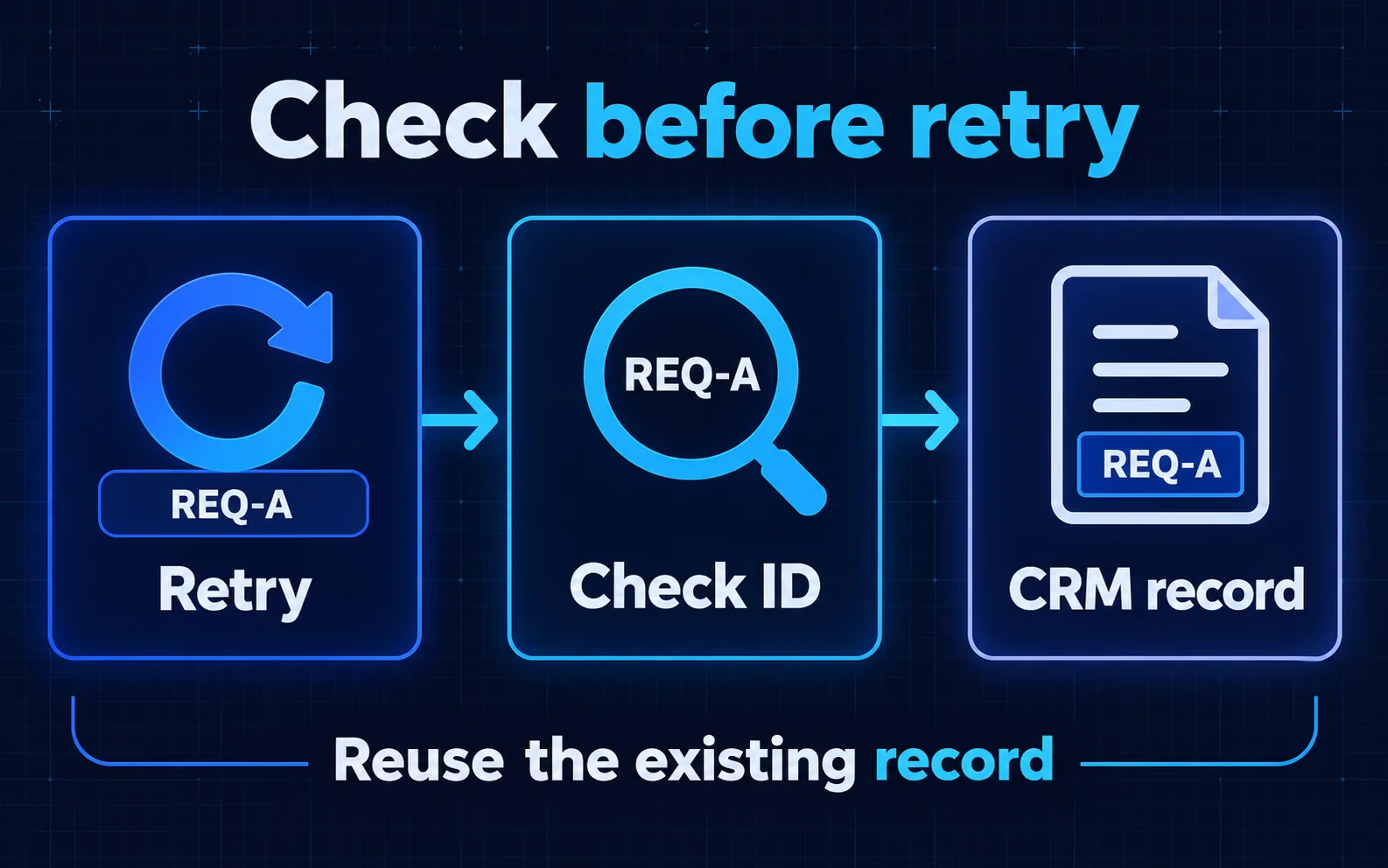
Proposed rule for the hypothetical example: check the request ID and reuse its existing record before completing the notification. Test this behaviour in the delivered integration.
Add AI where the task requires interpreting text or suggesting a category, and test that step separately. Moving a known identifier or checking a required field can follow explicit rules. For an Arabic sales enquiry, you might propose a category while keeping the original message beside it for a reviewer.
Test an ambiguous request and a message mixing Arabic and English. Specify how the employee corrects a category, stops processing and approves an external reply. Our guide to evaluation cases before running an LLM helps prepare the review set. Compare performance against written acceptance criteria and list model usage as a separate cost dependency.
Approve the proposal after the test and the operating responsibilities are clear. When discussing AI workflow automation with TecnoStack, we review the process, connections, approval points and retry tests, then confirm scope and price in the proposal. Compare the published plan with your requirements and document tool subscriptions, provider usage and additional development separately.
- Supply Arabic and English samples with expected outcomes for failure cases.
- Require evidence for the actual connections and permissions.
- Review usage units, operating costs and the assumptions behind each estimate.
- Rehearse recovery and duplicate checks with the employee who owns the workflow.
- Receive account access, documentation and the agreed handover files before closing the project.
Prepare your process map, system names and recurring failure cases, then discuss an automation trial for your team. Those inputs help establish what the first prototype must prove and which provider dependencies need confirmation before implementation.