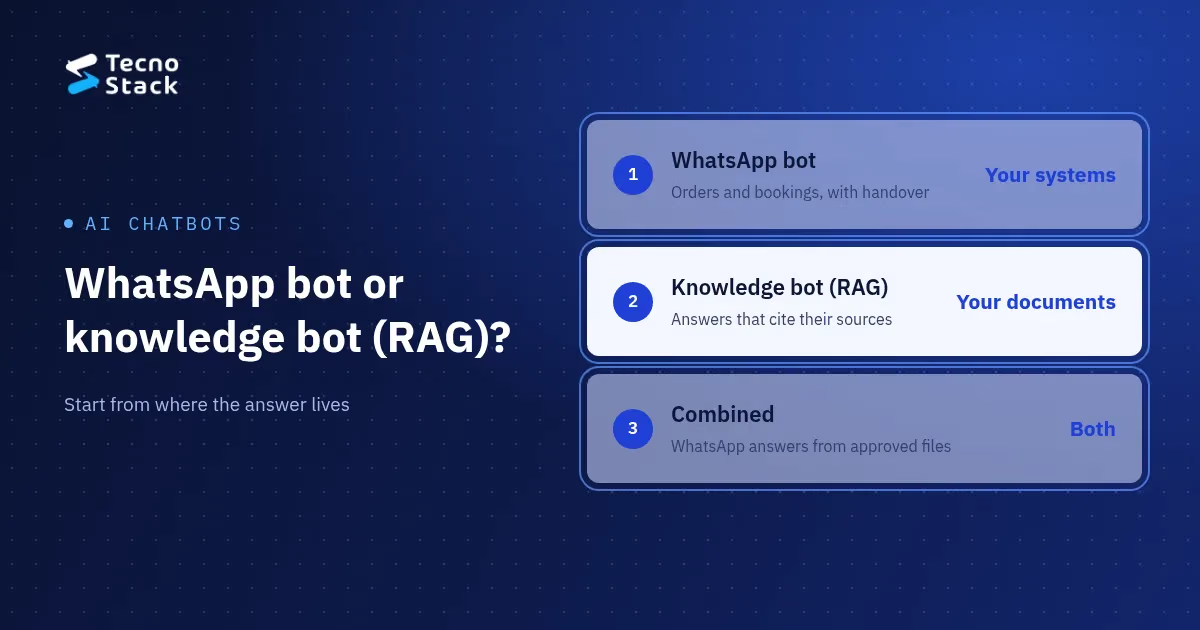
An AI chatbot for business is usually one of two projects. If customers ask about their own orders, deliveries or appointments, you need a WhatsApp bot connected to the system that holds those records, with a handover to your team. If people ask questions answered in documents, you need a knowledge bot built on RAG that cites its sources.
The two differ in where the answer comes from, who uses them, what can go wrong and what they cost. Twenty real messages from last month are enough to tell you which one to build first.
The deciding factor is where the answer to each question is stored. Take twenty real messages or questions from the last month and sort them into three piles:
- The answer is in a system. "Where is my order?", "Can I move my appointment to Thursday?", "Has my refund gone through?" The answer is a record in your store, booking system or CRM, and it changes from customer to customer. That is a WhatsApp bot's job.
- The answer is in a document. "What is the warranty on this model?", "What is our travel allowance for Jeddah?", "Which clause covers early termination?" The answer is the same for everyone with the same access, and it sits in a PDF, a policy or a knowledge base. That is a knowledge bot's job.
- A person has to decide. Complaints, exceptions, negotiations and anything with legal or medical weight. A bot should pass these to the right person fast and leave the decision to them.
If most of your sample lands in the first pile, start with WhatsApp. If most lands in the second, start with a knowledge bot. If it splits, read the section on combining them.
If none of the piles fits because the real goal is to take repetitive work off your team, look at these small-business automation examples before you commit to a chatbot.
A WhatsApp chatbot answers customers about their own records through guided flows. It recognises the request, looks up that customer's order or booking, replies with the real status and hands over to a person when the flow cannot help. It can also send updates your team types by hand today, such as order confirmations and appointment reminders.
Plan for Meta's platform rules from the start, because they decide what the bot may send and when. As of October 2026, according to Meta's documentation:
- Free-form replies only inside the window. A customer's message or call opens a 24-hour customer service window, and each new message resets it. Outside it you can send only approved message templates.
- Opt-in first. Meta's Business Messaging Policy lets you message people only after they give you their number and agree to hear from you. Article 25 of Saudi Arabia's Personal Data Protection Law separately limits advertising sent to a person's own contact details without their consent, so give marketing templates extra care.
- A clear path to a person. The same policy allows automation inside the 24-hour window but requires prompt, clear and direct escalation paths. A good bot passes the chat over with its history, so the customer does not repeat themselves.
- Per-message charges. Meta has charged per message since 1 July 2025, by category and the recipient's country. Budget for them on top of the build.
Our service for connecting WhatsApp to your systems sets this up as guided replies and handover. It starts from SAR 4,000 for one number on the WhatsApp Business Platform, up to 5 templates prepared for submission, a shared inbox for up to 3 users and one routing flow. The connected plan, from SAR 8,000, adds Arabic and English templates, up to 10 templates and 3 routing flows, one documented CRM or store API integration, and consent, opt-out and escalation set up. The provider bills its subscription and Meta's charges directly, and we cannot promise template approval or verification. An AI agent that handles free-text requests inside those chats is scoped as a separate service.
Before you pick a provider, our WhatsApp guide walks through Meta's Saudi rates, template categories and choosing Cloud API or a BSP.
A knowledge base chatbot answers questions from your documents and shows where each answer came from. It works out what the person is asking, pulls passages from the files that person may see, checks whether they support an answer, and replies with links to the sources. When the documents do not support an answer, it should say so instead of guessing.
Internal teams usually come first: HR, operations, sales support and legal, whose questions sit in long documents with clear access rules. Customers can follow once the source documents are approved for public answers, for example product specifications or service terms. For the mechanics behind it, read a walkthrough of grounded retrieval.
Three things decide whether a knowledge bot works:
- The documents. They need to be current, owned by someone and machine-readable. Scanned PDFs need OCR first, and OCR is outside our standard plans.
- Permissions. The bot must check who may see each document when it retrieves passages, not only in the interface.
- Evaluation. You need a set of real questions, in Arabic and English if you work in both, including cases where the right answer is "I don't know". Our guide to labelling model errors consistently shows how to score the results.
We build a document Q&A system built on your files in stages. The knowledge assessment, from SAR 6,000, reviews up to 100 sample documents, maps one use case and its access rules, and produces a 30-question evaluation set, an architecture and a build estimate. Nothing is deployed in that plan. The RAG pilot, from SAR 30,000, covers up to 500 text documents or 5,000 pages, whichever is lower, in one language and from one source, with a private test interface that cites its sources. Model and API usage, hosting and major data cleanup are separate, and we do not guarantee answer accuracy.
The WhatsApp bot answers from records and serves customers; the knowledge bot answers from documents and usually serves staff first.
| Criterion | WhatsApp bot | Knowledge bot (RAG) |
|---|---|---|
| Where the answer comes from | A record in your store, CRM or booking system | Passages in your documents |
| Typical users | Customers | Employees first, customers once documents are approved |
| Main risk | Showing one customer's data to another, or a flow with no way out | A confident answer the documents do not support, or a document shown to the wrong person |
| Running costs | Meta's per-message charges and the provider's subscription | Model usage, hosting and someone's time keeping documents current |
| Starting price at TecnoStack | From SAR 4,000 | SAR 6,000 assessment, then a pilot from SAR 30,000 |
Prices are TecnoStack's published starting prices as of 21 October 2026, in SAR and before VAT where it applies. Your proposal confirms the final scope and price.
Combine them when customers ask on WhatsApp and some of the answers sit in documents, such as a returns policy, a product's specifications or a clinic's preparation instructions. WhatsApp stays the channel, and the knowledge bot becomes one source the flow can consult, next to the order lookup.
Build it in stages:
- Launch the WhatsApp flows for system lookups first. They are predictable and easy to test.
- Run the knowledge bot internally until its evaluation results satisfy you.
- Connect a narrow, approved set of documents to the WhatsApp flow, and keep the handover for everything else.
One platform rule matters here. Meta's WhatsApp Business Platform terms, last modified on 23 September 2026, bar AI providers from offering general-purpose AI assistants on the platform where the AI is the main product, outside the markets Meta lists. A bot that answers your own customers about your own business is a different use. Keep it scoped to your business and check the terms again when you plan it.
A chatbot fits when the same questions arrive again and again and the answers already exist somewhere. If your documents are thin or contradict each other, a knowledge bot will repeat those gaps to every person who asks, and a better prompt or a different approach may serve you first. Our guide to diagnosing whether you need RAG or fine-tuning helps you test that before you budget for a build.
Five answers make the first conversation much shorter:
- Twenty real questions, sorted into system, document and person.
- Which system holds the answers (store, CRM, booking system or documents) and whether it has a documented API.
- Which languages customers or staff use, including mixed Arabic and English.
- Who receives handovers, and during which hours.
- What personal data the bot will read, where it is hosted, and which AI services will receive customer messages or prompts.
WhatsApp platform facts in this article come from Meta's official pages as of October 2026. Check them again before you budget, because Meta updates its pricing and terms.
Bring your sorted list of twenty questions to a first call and we will tell you which bot to start with and what the first stage would cover. Send us your brief when you are ready.


