The WhatsApp Business API in Saudi Arabia lets a store send order updates, delivery notices and campaigns from its own systems, and answer customers from a shared inbox instead of one phone. You need a verified Meta business portfolio, a dedicated number, approved message templates, and either a solution provider or your own Cloud API integration.
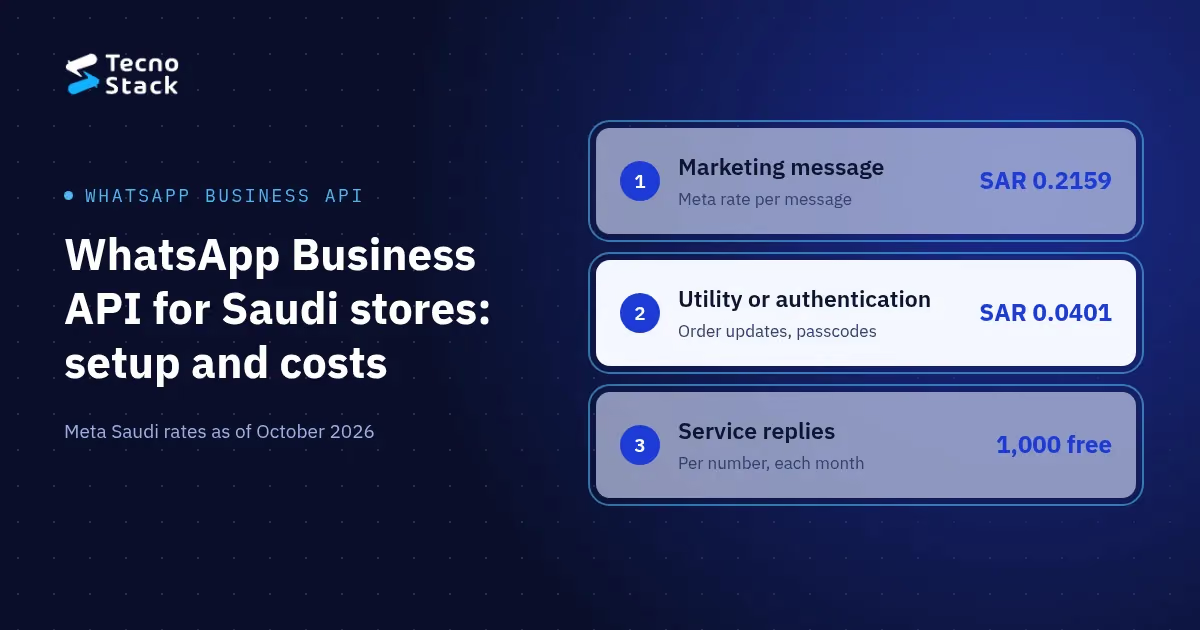
Meta charges per delivered message. As of October 2026, its rate card for Saudi Arabia lists SAR 0.2159 per marketing message and SAR 0.0401 per utility, authentication or service message, and every business phone number gets 1,000 free service messages a month. Those are Meta's charges only. A provider's subscription and the integration work come on top. Meta now calls the API the WhatsApp Business Platform; you will see both names.
The free WhatsApp Business app is enough while one or two people answer chats on a phone. Move to the API when several people need to share one number, when your store should send order updates without anyone typing them, or when chats need to land in a CRM with the customer's history attached.
The API has no app of its own. You run it through a provider's dashboard or through software you build. Outside the customer service window, which opens when a customer messages you, you can only start a conversation with an approved template.
You need six things in place before you request access: a business portfolio, a number, a profile, billing, templates and an opt-in method.
- A Meta business portfolio, ideally verified. Use your registered business name and make sure the details match your commercial documents. Salla's help centre advises against generic display names such as "Customer Support".
- A phone number for the platform. It can be a new number or one you migrate. Meta offers some routes for bringing a WhatsApp Business app number onto the platform, but not every provider supports them, so check the migration route before you move a number customers already know.
- A display name and business profile that customers will recognise.
- A payment method in Meta's billing, or through your provider. Meta says it stops delivering service messages for accounts without a payment method once those messages become chargeable, which they did on 1 October 2026.
- A first set of templates. Write the handful of messages you need at launch, such as order confirmation, shipped and delivered, before you write campaigns.
- Customer opt-in. WhatsApp's Business Messaging Policy lets you message people only after they give you their number and agree to hear from you on WhatsApp. Give them a simple way to stop. If you collect numbers through your website, our guide to PDPL compliance for contact forms covers what the form has to tell people.
WhatsApp API pricing is per delivered message, set by the message category and the recipient's country calling code. Messages to +966 numbers use the Saudi rates, and messages customers send you are free. Meta switched from per-conversation to per-message charging on 1 July 2025. These are the SAR list rates on Meta's rate card effective 1 October 2026:
| Message category | What it is for | Meta rate per message (SAR) |
|---|---|---|
| Marketing | Offers, launches, back-in-stock campaigns | 0.2159 |
| Utility | Order confirmations, shipping and delivery updates | 0.0401 |
| Authentication | One-time passcodes for login or checkout | 0.0401 |
| Authentication-international | Passcodes, for eligible high-volume senders | 0.2240 |
| Service | Free-form replies inside the 24-hour window, after the free 1,000 | 0.0401 |
Three rules move the bill more than the rates do:
- The free tier. Each business phone number gets 1,000 free service messages a month. They reset monthly and do not roll over. Meta charges from the 1,001st.
- Utility templates inside the window are now charged. Until 30 September 2026, a utility template sent while the customer service window was open was free. Since 1 October 2026 it costs the utility rate.
- Free entry points. When a customer messages you from a click-to-WhatsApp ad on the Android or iOS app and you reply within the window, Meta opens a free entry point window of up to 7 days. Marketing, utility, authentication and service messages in that window are free.
Utility and authentication messages also have volume tiers. In Saudi Arabia, the list rate covers the first 100,000 utility messages and the first 300,000 authentication messages a month, and the rate steps down above those. Meta may change rates only on the first day of a quarter, and it raised the Saudi marketing rate on 1 October 2026, so check the official WhatsApp Business Platform pricing page before you set a budget.
An illustrative monthly bill
Take a store that sends 2,000 order updates as utility templates, one campaign to 3,000 customers who opted in, and 1,500 service replies in a month, all to Saudi numbers:
- Order updates: 2,000 × SAR 0.0401 = SAR 80.20.
- Campaign: 3,000 × SAR 0.2159 = SAR 647.70.
- Service replies: the first 1,000 are free, then 500 × SAR 0.0401 = SAR 20.05.
- Meta total: about SAR 748 for the month, before any provider fees and taxes.
The campaign is most of that bill. Order updates are cheap; marketing is where both the cost and the opt-out risk sit.
Pick a provider if your team needs an inbox next week, and the direct Cloud API if WhatsApp has to live inside software you already own. Meta hosts the Cloud API and switched off its older self-hosted On-Premises API on 23 October 2025, so every new setup runs on the Cloud API, through a provider or directly.
Through a Business Solution Provider (BSP). Providers active in Saudi Arabia offer onboarding, a shared inbox, a campaign tool, a template editor and local support. You pay the provider's subscription or markup alongside Meta's message charges, so compare the full monthly cost. Ask who owns the WhatsApp account and the number, and how you would move to another provider later.
Directly on the Cloud API. Your developers create the app in Meta's developer tools, register the number, receive webhooks and send messages from your own code. You pay no provider fee, but you build and maintain the inbox, template management, retries and monitoring yourself. This suits teams that already run their own CRM or support tool and want WhatsApp inside it.
Meta's per-message rates are the same on both routes.
Meta must approve every message you send to start a conversation outside the customer service window. Each template has a category (marketing, utility or authentication), a language and placeholders for details such as the customer's name or order number.
- Categorise honestly. A shipping update with a discount code attached is marketing, and Meta charges it as marketing.
- Write Arabic and English as separate templates. Each language version is its own submission, and the Arabic one should read as if a Saudi copywriter wrote it.
- Keep variables meaningful. "Your order {{1}} has shipped" is clear. A template that is almost all placeholders is more likely to be rejected.
- Start small. Five templates for order confirmation, shipped, out for delivery, delivered and failed delivery cover most store needs at launch.
No provider can promise that a template will be approved, or by when. Plan the launch around Meta's review, not a fixed date.
A WhatsApp Salla integration, or a Zid one, can take one of three routes: the platform's own channel, a third-party app, or a custom integration on the platform's webhooks. As of October 2026:
Zid's built-in WhatsApp. Zid offers a WhatsApp channel inside the store dashboard with order-status messages, abandoned-cart reminders, campaigns and a shared inbox. Zid says the channel is included in its Professional plan and costs SAR 109 a month on other plans, with messages paid from a points balance you top up. Check Zid's current terms for your plan.
Salla Chat and Salla App Store apps. Salla Chat can add WhatsApp as a channel. According to Salla's help centre, it needs a fully verified Meta business account, a number not previously used on WhatsApp and Meta's approval. The Salla App Store also lists third-party WhatsApp apps for order updates and abandoned carts. Check how each app connects: some link a number by scanning a QR code instead of using the Business Platform, which is a different arrangement from the API described here.
A custom integration. Salla's partner platform sends webhooks for events such as order.created, order.status.updated and abandoned.cart, and Zid offers APIs and webhooks through its partner dashboard. A custom integration listens for these events, picks the right approved template and sends it from your own provider or Cloud API account, then passes replies to your CRM. Choose this route when you want one WhatsApp setup across your store, CRM and support team, or when the ready-made apps miss a flow you need.
If your store is not live yet, work through the Salla launch steps first and add WhatsApp once orders are flowing. For the build budget, see the online store cost guide. Our Salla integrations work covers the store setup and configuring supported apps, and a WhatsApp app can be one of them.
TecnoStack handles WhatsApp Business API integration for stores and service teams. We map the conversations first, prepare the account, number and templates, connect the flows to the store or CRM that holds the answer, and design the handover to a person. Our implementation plans start from:
- Messaging setup, from SAR 4,000: one number on the WhatsApp Business Platform, up to 5 templates prepared for submission, a shared inbox for up to 3 users and one routing flow.
- Connected support, from SAR 8,000: Arabic and English templates, up to 10 templates and 3 routing flows, one documented CRM or store API integration, and consent, opt-out and escalation set up.
- Messaging operations, from SAR 15,000: up to 2 channels and 10 users, up to 20 templates and 5 routing flows, up to 2 documented integrations and error handling.
These are one-time implementation fees in SAR, before VAT where it applies, and your proposal confirms the final scope and price. Training is one 60-minute session, and setup support covers defects in the delivered scope for 30 days. Meta and any provider bill their own charges separately. We cannot guarantee account approval, verification or template approval, because Meta decides.
If you want a bot to answer some of these chats, read when a chatbot needs RAG before you scope it; AI agents are a separate service. Our list of which SME processes to automate first shows where WhatsApp enquiries can feed a workflow that a person approves.
Answer these six questions and you have most of a scope:
- Which conversations do you want to automate first: order updates, abandoned carts, appointments or support?
- Which number will you use, and is it on the WhatsApp Business app today?
- A provider, the direct Cloud API, or your store platform's built-in channel?
- Which templates do you need at launch, and in which languages?
- Where should a chat go when it needs a person, and what context should travel with it?
- How will customers opt in, and how will they stop messages?
Meta's rates in this article come from its official SAR rate card effective 1 October 2026, checked on 21 October 2026. Zid and Salla details come from their own pages on the same date. Platform and provider prices belong to those companies and change over time. TecnoStack's prices are the starting prices published on our service page on 21 October 2026.
When you have rough answers to the six questions, tell us about your setup and we will reply with a scope and a starting price.


