Whether to run an open-weight Arabic-capable model yourself or call a hosted multilingual model through an API is mainly an operational decision, not a question of which model ranks highest. Settle it from four facts about your workload: where the data may be processed, how much control you need over versions and behavior, what your team can operate reliably, and what your own evaluation shows for both options.
Which model family handles your tasks best is a separate question, answered by testing; our guide to comparing Arabic LLMs fairly covers that method. This article is about where and how the chosen model runs.
A hosted model through an API. A provider runs the model; your application sends prompts over the network and receives answers. The provider controls model versions, available regions, retention terms and retirement dates, within whatever your contract guarantees. A hosted service can shorten setup and delegate model-serving capacity, but you still own application scaling, quotas and outage handling, and depend on the provider's roadmap.
An open-weight model you run. You obtain the weights under a license and serve them on your own hardware or in a cloud account in a region you choose. You can choose the model version and deployment region, while accounting for cloud-provider terms, logs, backups and supporting services. You also own capacity, uptime, security patching and every upgrade.
Between the two sit managed options: an open-weight model served for you by a third party in a region you select, or a private deployment offered by a provider. They trade some control for less operational work, and their terms need the same scrutiny as any hosted API.

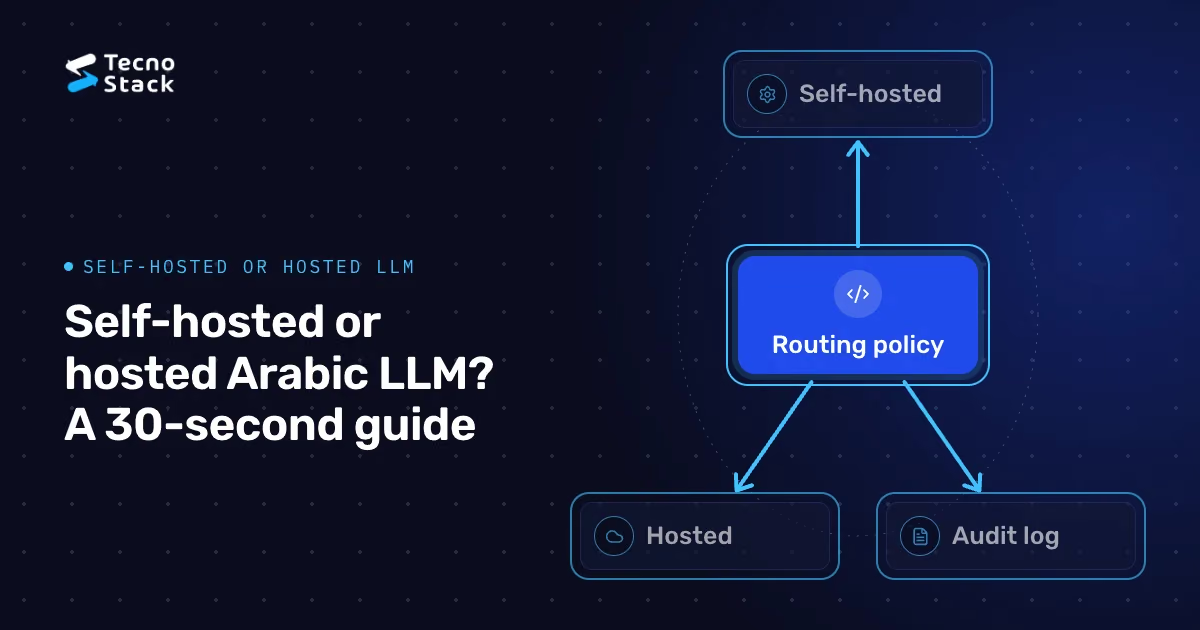
Figure 1 — Choose how your Arabic model runs. Match deployment to the workload.
Classify the data each use case will send to the model before comparing options. Public product information, internal policies, customer conversations and health or financial records lead to different answers.
For hosted options, get written answers to four questions: in which regions prompts and outputs are processed, how long they are retained, whether they are used for training, and which sub-processors are involved. Self-hosting gives you direct control over location, but location is only part of the picture, because data protection law also asks about lawful basis, purpose, security and transfers. Our PDPL data-flow checklist explains what your legal team will ask about for Saudi operations.
For open-weight candidates, the model card describes intended use and capabilities; the applicable license and terms govern permitted use. The model card for ALLaM-7B-Instruct-preview, published on HUMAIN's Hugging Face page, lists 7 billion parameters, a 4,096-token context, Arabic and English support and an Apache-2.0 license, and names the National Center for AI at SDAIA as developer. Those facts apply to that preview checkpoint only. The context length matters operationally: a retrieval prompt with several long passages may not fit, which changes how you chunk documents.
MBZUAI announced Jais 2 with Inception and Cerebras and presents it as an open-weight release. As with any family, including Falcon, check the license, size and usage terms of the exact checkpoint before planning around it.
For hosted models, the equivalents are the terms of service, data-use commitments, regional availability and the provider's retirement policy. Note when any version you depend on is scheduled to retire.
Self-hosting is not a single task. It includes planning GPU capacity for peak load, running an inference server, monitoring latency and errors, scaling, applying security updates, controlling who can call the model, keeping logs within retention rules, and re-running your evaluation whenever the model or serving stack changes. Someone has to be on call for all of it.
A hosted API moves most of that to the provider but adds its own work: handling rate limits and outages, tracking version retirements, monitoring spend and managing the vendor relationship.
Compare total cost, not token prices against GPU prices. On the self-hosted side, include people, idle capacity, redundancy and evaluation time; on the hosted side, usage growth, premium features and switching cost. There is no universal break-even point, so calculate it from your own expected volumes and reliability requirements.
Where hosted processing is permitted, run the same Arabic test set on a self-hostable candidate and a hosted multilingual baseline, under comparable conditions and scored by native speakers. Use only test data permitted on both routes; record unavoidable differences in tokenization, settings and serving configurations. If a smaller open checkpoint falls short, identify the kind of gap. Missing knowledge usually calls for retrieval; inconsistent format or tone may respond to better instructions or, sometimes, fine-tuning. Our guide to choosing between fine-tuning, RAG and prompt engineering helps diagnose which. A trade-off can be accepted only within the use case's required quality and safety limits, with its rationale recorded. Cost or control does not excuse failures of mandatory security or legal requirements.
Anthropic's engineering guidance on building agents recommends finding the simplest solution that works and increasing complexity only when it is needed, weighing the trade-offs; the page also marks its December 2024 examples as historical. We apply the same discipline to deployment. If no requirement forces self-hosting, a hosted model is usually the simpler start. If data rules or control requirements do force it, self-host the smallest model that passes your evaluation and add capacity when measurements justify it.
Whichever you choose, keep prompts, retrieval and evaluation independent of a single provider, to reduce switching effort. A new provider may still require prompt, tool-schema and error-handling adaptations, followed by a full evaluation; it is rarely only a configuration change. Some organizations route by data class: sensitive requests to a self-hosted model and general requests to a hosted one. That split works only if the routing rule is enforced in code, tested, and logged with the model that served each request. Enforce classification before dispatch, prevent automatic fallback into a disallowed route and apply the same rules to logs and evaluation data.

Figure 2 — Enforce approved data routes. Block fallback across data boundaries.
Write down the data classes involved and where each may be processed, the candidate checkpoints and their licenses, the evaluation results per slice, the operating owner, the expected cost range and the exit plan. Revisit it when a new checkpoint appears or your data rules change.
These recommendations are TecnoStack's guidance, not requirements of any model developer. If you are deciding how to run an Arabic-capable model in production, our AI systems service can help you evaluate the options and plan the deployment.
- HUMAIN. ALLaM-7B-Instruct-preview model card: parameters, context length, languages, license and developer for this preview checkpoint.
- Mohamed bin Zayed University of Artificial Intelligence. Jais 2 release announcement, with Inception and Cerebras.
- Anthropic. Building effective agents: engineering guidance that recommends starting with the simplest solution and adding complexity only when needed.