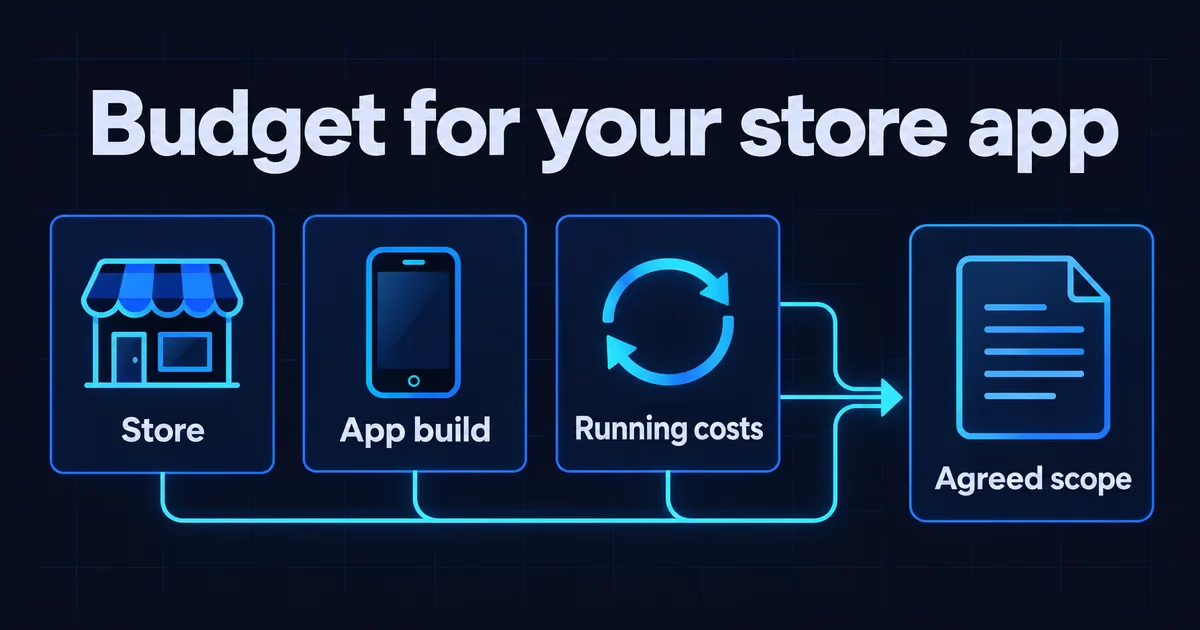
Ecommerce app development cost includes the app, its store connections and ongoing operation. As of October 2026, TecnoStack's mobile plans start at SAR 20,000 before VAT where applicable, for a defined scope. A complete shopping app needs a proposal confirming its functions, integrations and running costs.
Start with the store you already operate. List where you manage products, stock and orders, and identify what the app can reuse. If you are starting from nothing, use the store budget before adding a mobile channel to separate the two projects. Ask suppliers whether they will use your existing administration system before approving another dashboard.
Commission an app when you can name a recurring customer task it should improve and the person who will operate it after launch. Reordering familiar products or checking an existing order are possible tasks to investigate. Record how customers complete the task today, then test your proposed flow before committing to a long feature list.
Review the mobile website first. Find a product, select a variant, enter an address and complete an order. If delivery charges are unclear or product availability is wrong, assign someone to fix the store. Carrying the same issue into an app gives your team another place to maintain it.
Agree how you will assess usefulness. Downloads alone do not demonstrate that customers completed the task or that the investment paid back. Choose a review period and record the evidence you can collect. Postpone the app if you cannot yet explain its purpose, staff its operation or fund its maintenance; continue improving the store customers already use.
Check your existing platform's app option against your required shopping flow before commissioning custom work. As of October 2026, Salla offers an app maker connected to store management. Verify current eligibility, features and subscription terms for your account. Having a Salla store does not itself establish that its app subscription is included.
As of October 2026, Zid's mobile-app documentation says merchants can manage app content, products and orders from the same Zid dashboard. Request the applicable app package and test your actual requirements, including the discounts, customer accounts and extensions you rely on. A general feature description is a starting point for that review.
For Shopify, the official mobile-storefront guide, as of October 2026, describes Storefront API for products and carts and Checkout Kit for presenting checkout. These are integration tools; they do not establish that your store subscription includes designing and delivering your own app. Ask the developer to demonstrate the proposed flow and identify the remaining implementation work. Compare every option against the same requirements, including what happens when an order fails.
As of October 2026, TecnoStack lists project starting prices of SAR 20,000, SAR 40,000 and SAR 70,000 for its mobile-app plans, before VAT where applicable. Each covers iOS and Android in Arabic and English, with its own screen, role and integration limits. These are mobile-development scopes; a complete shopping app requires an explicit fit assessment.
Review ecommerce app development cost against the service details, and use the mobile-plan limits to check before requesting a quote to prepare your brief. An included order-request form does not establish an unlimited catalogue, cart, inventory and returns system. Name each requirement and ask whether your store supplies it or the developer must build it.
Developer accounts, hosting, provider charges and ongoing maintenance remain separate under the published scope. Confirm work outside the selected plan before committing. The published service-price reference helps you identify starting amounts, while your proposal confirms the final scope and price. Keep the proposal's date and validity period beside your comparison; screen counts alone cannot settle the budget.
Ask each supplier to price the same deliverables and describe how you will accept them. Leave an unquoted item marked pending, with an owner responsible for obtaining the amount. A blank cell is not evidence that someone will supply the work for free.
| Work item | What should you define? | Suggested acceptance evidence |
|---|---|---|
| App design | Screens, languages and error states | Clickable version of the agreed flow |
| Catalogue | Source of products, images and variants | Test product with matching data |
| Cart and order | Discounts, delivery and payment route | Matching app and store order |
| Accounts | Login and required customer data | Agreed access and permission tests |
| Integration | Each system, interface and owner | Recorded connection tests |
| Release | Accounts, materials and devices | Approved build and submission checklist |
| Operation | Recurring fees and maintenance responsibilities | Explicit support agreement |
Define a design revision and what happens if you add a shipping method after approval. Name the person supplying Arabic copy and product images, and the person checking the sales terms. Agree the permissions a supplier needs and how you will revoke access after handover. This worksheet is a suggested buying process, without expanding any published package.
Choose the authoritative source for each type of data and ask the developer to show that the app follows it. Products might live in the store while another system holds stock. Document that relationship before pricing the connection, including who investigates a failed update and how your operations team sees the problem.
Follow an illustrative test order through the proposed route: a customer selects a product in the app, submits the order to the store and receives the order status confirmed by the system. Compare the product, quantity, total and order identifier on both sides. Pressing a purchase button does not demonstrate successful payment; test the provider's returned status through the agreed integration.
Include failure cases. Ask what the customer should see when stock runs out during checkout, the connection drops after submission or they retry. Request evidence that the same attempt does not create unwanted duplicate orders. For cancellation and returns, name the system that starts the change and specify how the app displays it. Verify support for those requirements rather than assuming every extension implements them identically.
Keep a record linking each requirement to its test result and repair owner. If a required interface is missing, obtain a quote for the alternative before implementation and reconsider the app option if necessary. Attach these decisions to the proposal so the phrase “store integration” has an agreed meaning at delivery.
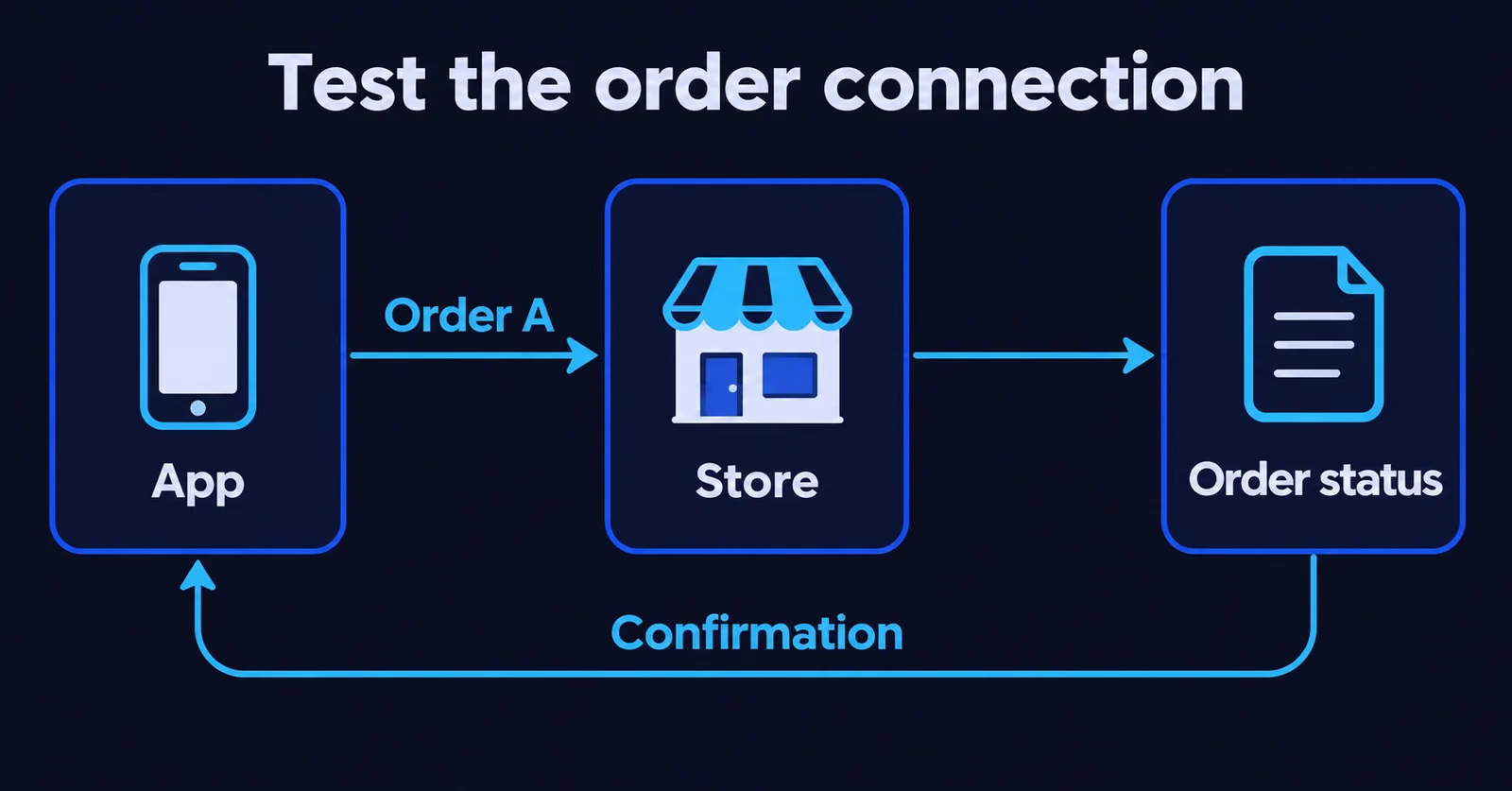
Illustrative test flow: match the app and store order, then display the status confirmed by the system.
Test the complete customer flow on the agreed devices, covering successful, cancelled and failed payments. Record what the customer sees and what the store records in each case. Name the owner of provider approval and charges, use the appropriate test environment, and keep sensitive data out of screenshots and diagnostic reports.
Specify notification types. An order-status update, a marketing message and a link to a particular product require different acceptance questions. Identify the source of each message and who approves it. Test the destination when an offer has ended, and confirm that customers can still find their orders if they decline notification permission.
Review Arabic during prototyping and again in the working app. Check long product names, mixed Arabic and Latin addresses, prices, keyboard behaviour and enlarged text. Inspect directional icons and the sequence of checkout steps. Record defects with reproduction instructions and a screenshot. Review these details before approving the design, so later changes have a clear owner and agreed treatment.
List recurring charges separately, naming the invoice issuer and renewal date. Include the store or app-builder subscription, publishing accounts, hosting where needed, external-service charges and agreed maintenance. Compare proposals over the same period, keeping one-time work separate from subscriptions and variable usage. Obtain missing quotes before treating the worksheet as a complete budget.
As of October 2026, TecnoStack includes fixes for defects in the delivered scope for three months on Focused app and six months on the other plans. Ongoing maintenance and new features remain separate, with compatibility-update allowances described in each plan. Read about separating app maintenance from delivery defect fixes before interpreting “support” as an open development commitment.
Confirm ownership of accounts, source code and signing keys, plus who can release an update if the supplier is unavailable. Request a handover list and a named contact for checkout failures. Agree how later work will be estimated and approved. When a supplier includes a subscription within its fee, identify it explicitly to avoid counting the same expense twice.
A useful comparison sheet has a column for the initial build, another for recurring commitments during your selected period, and a separate list of unknown costs. Record the assumptions behind usage-based charges. If you cannot support an assumption with your own records or a supplier quote, keep it unresolved instead of turning it into a forecast. Review the sheet when scope changes.
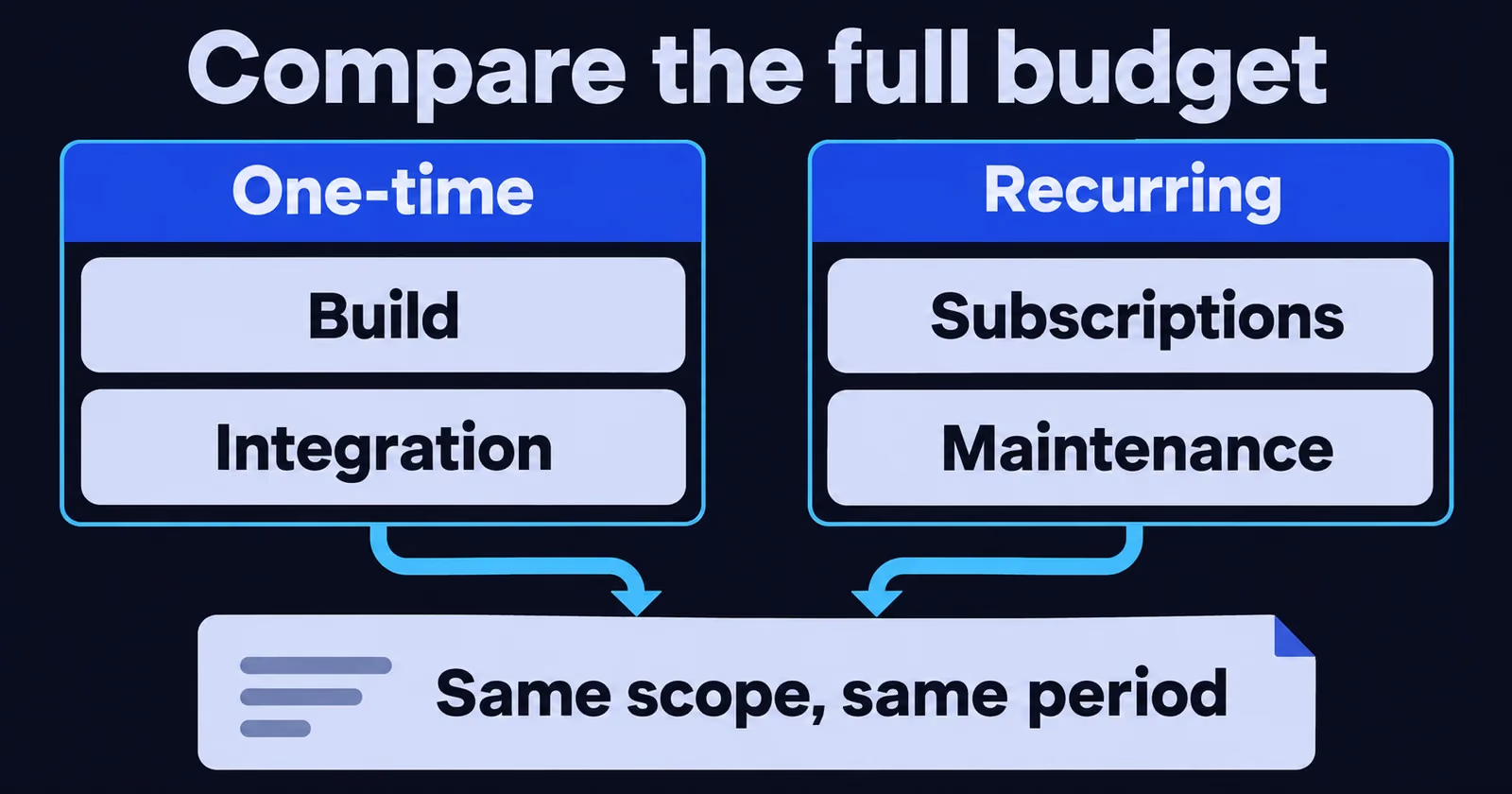
Suggested comparison: separate initial and recurring costs, checking included work to avoid counting the same expense twice.
Prepare a short brief describing the current store, the app's customer task and the functions you will defer. Attach available interfaces and data sources. Request a focused connection test if a critical dependency remains uncertain. Discuss the schedule after this review, separating supplier implementation from app-store and external-provider decisions; those dependencies require their own planning.
Before signing, check the proposal with your team:
- Does it identify what you will reuse and what the supplier will build?
- Have you named a testable purchase flow and its important failure cases?
- Does design review cover the agreed languages and devices?
- Are recurring charges, exclusions and account owners clear?
- Does acceptance require test evidence and files your team can receive?
The practical takeaway is to choose the smallest scope that demonstrates the app's purpose and works with your store, then fund its build and operation for a defined period. Resolve unknown integration work or recurring expenses before approval. Send the store URL and proposed customer task through a store-app scope discussion so we can review the requirements and prepare a comparable proposal.