
Email marketing metrics are useful when the report states what is counted, which population forms the denominator and how the outcome receives credit. Define those items before comparing campaigns. Two percentages with the same label can describe different activity, and attributed revenue does not establish the additional revenue caused by an email.
Start with one decision the report should support. You may need to diagnose delivery, improve a product destination or decide whether to continue a flow. Each decision needs a different combination of evidence.
Choose the action that matters for the message: a confirmed order, a qualified enquiry, a requested resource or another observable task. Identify the system that records it and the conditions under which it counts.
Then define the population. A report for messages sent during a week may include conversions that occur later inside an attribution window. A report for orders placed during the week answers a different question. Record whether the grouping follows send date or outcome date and use a consistent timezone.
Keep campaigns, automated flows and transactional messages identifiable. A comparison between a new-subscriber welcome message and a returning-customer offer needs to account for the different audiences and purposes. A higher rate alone does not tell the team which design would work better for the same people.
Use this worksheet to agree definitions. The formulas shown are reporting choices for your team to confirm, not a claim that every provider uses these labels or denominators.
| Metric or record | Definition to agree | Important limitation |
|---|---|---|
| Delivery rate | Accepted messages divided by attempted sends for the same cohort | Acceptance does not establish inbox placement |
| Unique click rate | Unique recorded clickers divided by delivered recipients | Record bot filtering and what counts as a click |
| Attributed purchaser rate | Distinct purchasers credited under the chosen rules divided by the stated recipient population | Purchasers, orders and conversions are different counts |
| Attributed revenue | Revenue attached to credited outcomes under the selected model and window | State discounts, tax, shipping, currency and refund treatment |
| Unsubscribe and complaint measures | Events and denominator as defined by the reporting provider | Different providers may use different populations |
| Goal-event evidence | A traceable event and the source record it represents | A page view or button click may not be a confirmed business outcome |
Use the deliverability checklist when the first row is the problem. A campaign can have a working link and a sound revenue definition while its messages are being rejected or routed unexpectedly.
Apple's Protect Mail Activity can download remote content in the background regardless of whether the recipient engages with the email. An open recorded through that mechanism cannot be read as proof that a person deliberately opened and read the message. Apple Mail Privacy Protection
Clicks also need a definition. Record whether the report uses total clicks or distinct recipients, which links are included and how automated activity is treated. Klaviyo provides settings for excluding bot clicks and Apple privacy opens, with different effects on reporting and attribution. Check the actual account settings rather than assuming a filtered dashboard measures only human intent. Klaviyo attribution settings
If the team changes these settings, record when and why. A changed definition can alter the comparison with an earlier report even when no customer behaviour has changed.
Write down the conversion event, eligible interactions, lookback window and attribution model. State whether opens can receive credit, whether clicks alone qualify and how other channels participate.
Klaviyo attributes conversions when eligible interactions meet the account's configured window and model. Its documentation also explains that reports grouped by message send date can accumulate later conversions, and that changing attribution settings can update historical results. Save the relevant settings and report timestamp with each comparison. Klaviyo conversion tracking
Give recent messages enough time to complete the agreed observation window before comparing final outcomes. If an early report is needed, label it provisional and compare cohorts at the same stage. Extending a window to make the revenue figure larger changes the rule; it does not demonstrate that the campaign improved.
The following numbers are invented for a calculation exercise. They are not TecnoStack results or industry benchmarks. Assume one message per recipient, a seven-day click-only attribution rule for this exercise and a later, agreed snapshot for refunds. These are example reporting choices, not provider defaults.
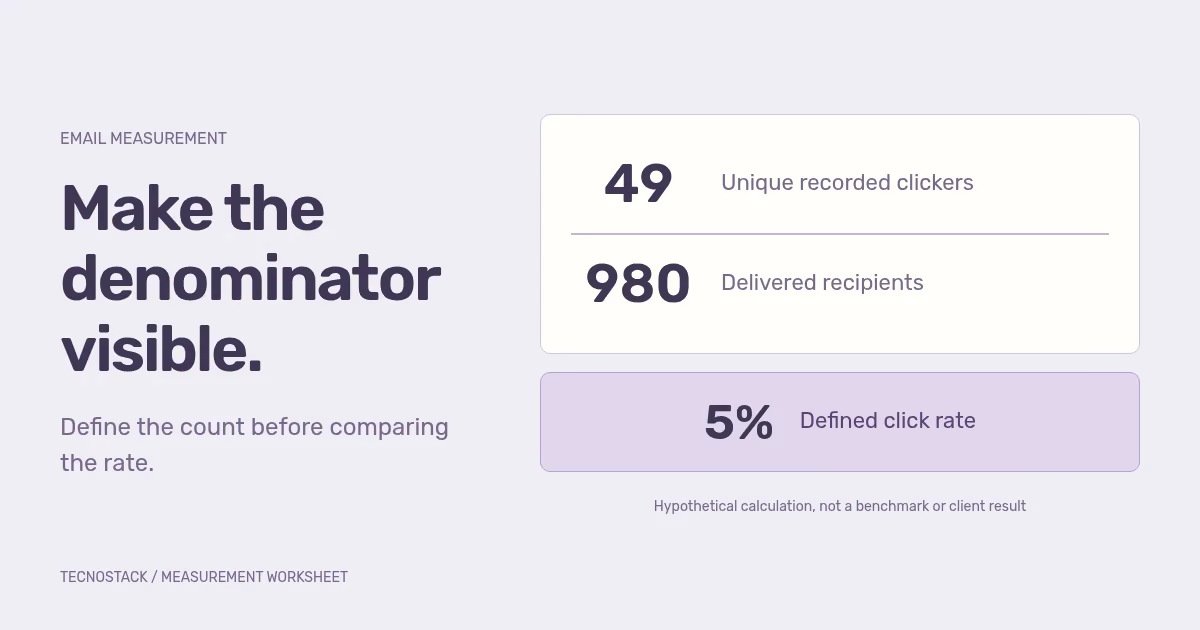
The campaign attempts 1,000 sends. The receiving systems accept 980 messages; 20 are finally not accepted. The report records 49 unique clickers after its stated bot-filter settings. Under the example attribution rule, 20 distinct customers place 20 credited orders.
Those orders contain SAR 2,940 of merchandise revenue after discounts, excluding tax and shipping. Three orders are later fully refunded for a total of SAR 420. For this worksheet, the net attributed merchandise revenue is therefore SAR 2,520. The team performs that reconciliation explicitly; it does not assume every dashboard deducts refunds in the same way.
| Calculation | Worked result | What the result means |
|---|---|---|
| Delivery rate | 980 of 1,000 attempts = 98% | Server acceptance for this cohort |
| Unique click rate | 49 of 980 delivered recipients = 5% | Recorded unique clickers under the stated filtering |
| Initial attributed purchaser rate | 20 of 980 delivered recipients ≈ 2.04% | Distinct purchasers credited before considering refunded-order retention |
| Net attributed merchandise revenue | SAR 2,940 minus SAR 420 = SAR 2,520 | Credited merchandise revenue after the stated refunds |
| Net attributed revenue per delivered recipient | SAR 2,520 divided by 980 ≈ SAR 2.57 | The worksheet's revenue and denominator combined |
There are 17 orders remaining after the three full refunds. Keep that retained-order count separate from the original count of 20 purchasers; the report should explain which one it presents.
None of these calculations gives profit or return on investment. Product costs, provider charges, content work and other relevant costs are absent from the example. Nor does the calculation show how many of the purchases would have happened without the message.
Use consistent campaign tags on the destination links and verify the resulting traffic-source values. Google Analytics supports manual UTM tagging for source, medium and campaign information. The tag names should describe the campaign consistently across its language variants and messages. Google manual tagging guidance
Keep personal details out of those values. Google's Analytics guidance requires campaign parameters and URLs to be free of personally identifiable information. Use a campaign label, not a recipient's email address or phone number. Google Analytics data guidance
GA4 also distinguishes user, session and event scopes. Comparing a session-source report with message attribution can therefore mix different questions. Match the event, date range, timezone, scope and attribution assumptions, then trace a representative order through both systems where available. Google traffic-source scopes
Keep the order system as the reference for the order facts while documenting how each reporting tool assigns credit. Do not force two dashboards to agree by changing definitions until the numbers happen to match.
Pair the outcome with a specific observation. If recipients click but encounter an unusable checkout, review that destination. If a cart reminder is correctly skipped after purchase, preserve that exclusion. The cart-email workflow guide helps distinguish a working stop rule from a broken flow.
Record the proposed change, the expected observable effect and the next review date. If you need to know incremental impact, define a separate evaluation with an appropriate comparison; a platform's attribution figure cannot answer that causal question on its own.
For a reporting brief, share the goal event, metric dictionary and current attribution settings with TecnoStack's email marketing service. The scope can then identify missing tracking, report definitions or operating work without promising a fixed return.


