
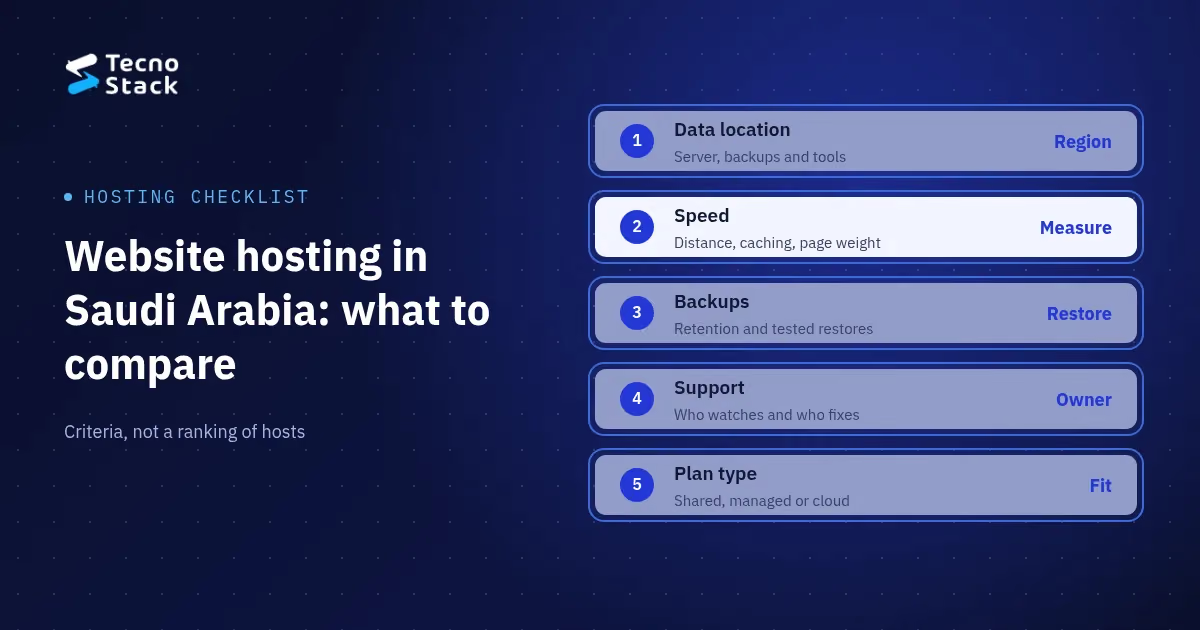
The best website hosting in Saudi Arabia is the plan that fits four answers: where your data has to live, where your visitors are, how quickly you need the site back after a failure, and who looks after it. Settle those first. Then compare data location, speed, backups, support and plan type, and only then price.
No host is the right answer for every site. A company website with a contact form, a WooCommerce store and a customer portal each need something different, and the sections below show how to tell which one you are buying for. Our own managed plans and prices in SAR are near the end.
Start with the data, because it decides how much the hosting location matters. List what the website stores. A marketing site with a contact form holds names, phone numbers and messages. A store or portal may hold addresses, order histories and account details.
Saudi Arabia's Personal Data Protection Law sets rules for processing personal data, including transfers outside the Kingdom. Whether a particular website must be hosted in Saudi Arabia depends on the data, your sector and any requirements from your regulators or clients. This article is not legal advice. Our guide to where personal data may be processed sets out the questions to take to your legal team, and the Saudi PDPL website checklist covers the privacy notice, forms and cookies.
The web server is rarely the only place your data goes. Ask where these live too:
- Backups, which may sit in a different region from the server.
- Email and form services, which often run on separate platforms.
- Analytics, chat and CRM tools that receive data from your pages.
- Content delivery networks (CDNs), which cache copies of files in many locations.
As of October 2026, Google Cloud and Oracle Cloud run regions inside the Kingdom, Microsoft has set a November 2026 opening for its Saudi region, and AWS has announced one that is not yet live. Here is what each provider's own pages say:
- Google Cloud runs a Dammam region (me-central2). Customers with a Saudi billing address buy Google Cloud through CNTXT, Google's reseller in the Kingdom.
- Oracle Cloud lists two Saudi regions: Saudi Arabia Central in Riyadh and Saudi Arabia West in Jeddah.
- Microsoft announced on 31 August 2026 that its Saudi Arabia East region, in the Eastern Province with three availability zones, will be available to customers in November 2026.
- AWS lists a Saudi Arabia region among its announced regions, not yet among the available ones.
A cloud region gives you infrastructure, not a running website. Someone still has to set up the server, deploy the site, run backups and respond to alerts. Many local hosting companies also run servers in Saudi data centres, so ask any provider which facility your site would run in, and get the answer in writing.
Hosting in the Kingdom shortens the distance between the server and visitors in Saudi Arabia, so each request spends less time travelling. For most websites, though, distance is a smaller factor than these:
- Page weight. Large images, videos and scripts slow a page wherever the server is.
- Caching. A CDN can serve images and static files from a location near the visitor, even when the server is elsewhere.
- Server resources. A busy shared server or a small plan can slow every page under load.
- The application itself. Slow database queries and heavy plugins add time to every request.
Measure instead of assuming. Test your key pages from Saudi locations before and after a move, and look at what real visitors experience in field data. Our guide to Core Web Vitals thresholds explains which numbers to watch and what counts as good.
Every host says it takes backups. Four questions separate a useful backup from a reassuring line on a sales page:
- How often are backups taken, and how long are they kept?
- Where are they stored, and is that inside or outside the Kingdom?
- Who can restore the site, and how long does a restore take?
- When was the last restore tested? Until someone restores a backup, you do not know it works.
Agree how much data you can afford to lose and how long the site can be down. Then check that the backup schedule and restore process fit those two numbers.
Most website outages start outside the host's hardware: a plugin update breaks a page, a certificate expires, a form stops sending email. What matters is whether someone is responsible for noticing and fixing it. Before you sign, ask:
- Who monitors availability, and who receives the alerts?
- Who applies updates to the website, its plugins and the server?
- What support hours apply, and in which language?
- What does the plan include, and what is billed per hour?
- Who owns the hosting account, the domain and the DNS?
Keep the domain and DNS in an account your company owns. Then you can move host without asking anyone's permission.
Shared hosting suits a small site with a technical owner on staff, managed hosting suits a company site without one, and a VPS or cloud server suits custom applications. The table compares the three.
| Type | What you get | Who looks after it | Usually suits |
|---|---|---|---|
| Shared hosting | Space on a server shared with other sites | Mostly you | Small sites with a technical owner on staff |
| Managed hosting | Shared or dedicated space plus setup, backups, monitoring and updates | The provider, within agreed time | Company websites and WordPress sites without an in-house admin |
| VPS or cloud server | Your own virtual server with set resources | You, or a managed-service partner | Applications, portals and stores with custom code |
Shared hosting is the cheapest line on the invoice, and someone on your team pays the difference in time. Managed hosting costs more because you pay for the care as well as the space. A VPS gives you control and room to grow, but it needs someone who can run a server properly. If your site is a store, our comparison of WooCommerce vs Salla shows what that upkeep means next to a hosted platform.
With TecnoStack, managed website hosting starts from SAR 149 a month for one site. These are monthly starting prices in SAR, before VAT where it applies:
| Plan | From (SAR/month) | Sites, storage and transfer | Backups | Maintenance |
|---|---|---|---|---|
| Managed starter | 149 | 1 website, 5 GB, 50 GB/month | Daily, kept 7 days | Up to 30 minutes a month |
| Managed business | 299 | Up to 3 websites, 15 GB, 150 GB/month | Daily, kept 14 days | Up to 1 hour a month |
| Managed growth | 599 | Up to 5 websites, 30 GB, 300 GB/month | Daily, kept 30 days | Up to 2 hours a month |
Every plan includes SSL setup and availability monitoring. The starter and business plans include one standard site migration and the growth plan includes two. We agree the hosting region with you before you buy. Domains, email, licences, overages and application development are billed separately.
Custom applications need their own server. Our managed VPS plans give you cloud infrastructure sized to your app, starting from SAR 399 a month for one managed Linux server and rising to SAR 799 and SAR 1,499 for larger servers and more management time. Those listed plans run in an agreed international region. We quote hosting inside Saudi Arabia, high availability and 24/7 response separately, so tell us early if your data needs to stay in the Kingdom.
Take these seven questions to any provider, including us:
- Which data centre and region will the site run in, and where are the backups?
- What resources does the plan include, and what happens when you exceed them?
- How often are backups taken, how long are they kept, and when was a restore last tested?
- Who monitors the site, who responds to alerts and during which hours?
- What maintenance does the plan include each month?
- Who owns the hosting account, the domain and the DNS?
- How does the provider handle a migration: staging, a cutover window and a way back?
If you are planning a new site as well, our guide to website design cost in Saudi Arabia shows where hosting sits in a first-year budget.
Send us your current host, plan and the data your site collects, and we will review your hosting and suggest a setup that fits.
We checked the provider region facts in this article on the providers' official pages on 21 October 2026. TecnoStack prices are the starting prices published on our service pages on the same date; your proposal confirms the final scope and price.


