To judge an internal AI copilot pilot, compare accepted outputs and total cost against a baseline you measured before launch. Accepted outputs are results people actually use with little or no rework. Total cost covers far more than model usage: integration, evaluation, review time, support and the work of keeping sources current. Usage counts and satisfaction scores add context but do not show value on their own. Agree in advance which result would justify scaling, adjusting or stopping, and do not promise a return before the pilot has measured one.
This article is about measurement. Choosing which workflow deserves a copilot in the first place is covered in our guide to selecting internal AI copilot use cases.
Before building, write a one-page pilot plan: the task, the users, the expected direction of change, the measures and the decision each possible result would trigger. For example: "For first drafts of customer replies in the support team, we expect less time per reply without more corrections from team leads. If accepted drafts do not save time after review, we stop." The business owner should agree success thresholds with operations, engineering, security and legal owners. Business value cannot waive mandatory security, privacy or legal gates.
Keep "ROI" out of the plan until costs are counted. A pilot is an experiment, and one legitimate conclusion is that the copilot is not worth running.
You cannot show improvement without a "before". Measure the current process for long enough to see its normal variation:
- Time per task, from systems of record where possible, otherwise from sampled self-timing.
- Quality: rework, corrections by reviewers, and escalations or complaints linked to the task.
- Throughput and backlog: how many tasks are completed, and how many wait.
- Cycle time: how long a request takes from arrival to completion.
Record how the baseline was measured so the pilot uses the same method. Compare similar tasks, difficulty and user experience, using a concurrent comparison group or randomized assignment where practical. Report sample size and variability; a simple before-and-after difference alone does not prove causation. If the process changes during the pilot for other reasons, such as new staff or a new policy, note it; otherwise the copilot gets credit or blame it did not earn.

Figure 1 — Measure a fair baseline. Compare similar tasks and users.
Usage shows engagement but does not establish value on its own. For each output in the pilot, record what happened to it: accepted as-is, accepted after edits, or rejected. Ask reviewers for a short reason when they reject or heavily edit an output, and add minimized, permitted examples to a controlled test set; our guide to evaluating LLM hallucinations explains how to label them consistently.
The useful measures follow from that log: the share of outputs accepted, time per accepted output including review, and whether quality held, judged by the same corrections and escalations as the baseline. Review time is part of the cost. A draft that takes as long to check as it would to write shows no time saving by that measure; any quality or throughput benefit needs separate evidence. Include time spent on rejected attempts, retries and manual fallback. Define the denominator and distinguish minor edits from substantial rework so a high acceptance rate cannot hide extra labor.
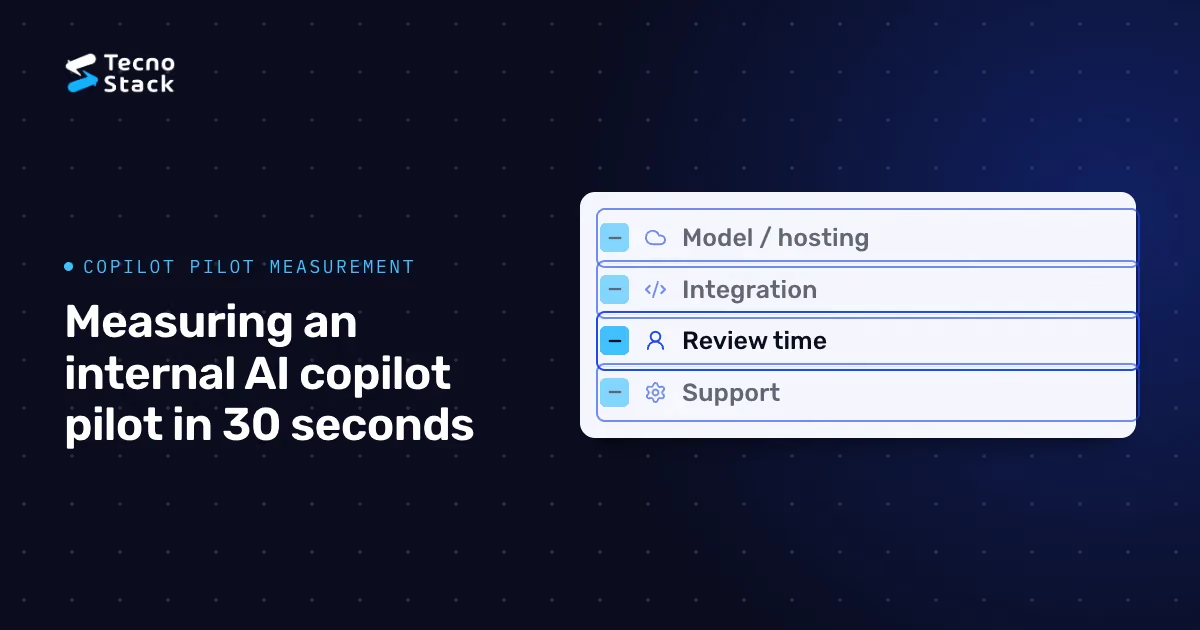
The share of model or API charges varies by workload; measure it rather than assuming it dominates or is negligible. A fair total includes:
- One-time work: integration with source systems and identity, data preparation, the evaluation set, security and privacy review, and user guidance.
- Recurring costs: model usage or hosting, infrastructure, monitoring, evaluation re-runs after changes, human review time, support, and keeping prompts, sources and indexes current.
- Change costs: staff training, updated procedures and vendor management.
Design choices move these numbers. Anthropic's engineering guidance on building agents notes that agentic systems often trade latency and cost for better task performance, and recommends adding that complexity only when it is needed. A simple drafting workflow is usually cheaper to run, and easier to measure, than an agent.
The AWS Well-Architected Framework is a useful checklist for this review. It organizes architecture questions into six pillars: operational excellence, security, reliability, performance efficiency, cost optimization and sustainability. Many principles apply beyond AWS, although service-specific recommendations require adaptation, and they surface costs pilots tend to forget, such as on-call support and recovery testing.
Report saved staff time as released capacity unless spending actually falls or measurable additional output realizes its value. For a financial ROI estimate over a stated period, use (realized incremental benefits minus incremental costs) divided by incremental costs, with a positive cost denominator. Separate one-time investment from ongoing costs and avoid counting the same labor saving both as a benefit and a cost reduction. Show assumptions and sensitivity rather than projecting a small pilot unchanged across the company.

Figure 2 — Count the full cost. Include review and maintenance.
A copilot should beat the best simple alternative, not just the status quo. Before scaling, ask whether better search over the same documents, a set of templates, a process change or an AI feature in software you already license would deliver most of the benefit at lower cost and risk. Our framework for SaaS versus custom software helps structure that build-or-buy comparison.
Put the pilot's figures next to the baseline: time per accepted output, the quality measures and total cost for the pilot period, with an estimate of how each would change at full scale. Then make one of three decisions:
- Scale if accepted outputs save meaningful time without lowering quality, and the total cost, including review, is justified.
- Adjust if the pattern of rejections points to a fixable cause, such as missing sources or unclear instructions, and run a second measured round.
- Stop if review time absorbs the savings or quality falls. That is a useful result too: it prevented a larger investment in the wrong place.
An illustrative reading: suppose most drafts in the support pilot are accepted after edits, and the edits cluster on one product line whose documentation is out of date. The time saved on other products is real, but scaling now would spread the same errors to more teams. The evidence points to adjusting: update that documentation, add the failing cases to the test set and run a second measured round.
Before scaling, revisit operational readiness: monitoring, support, access control and recovery. Record the decision with its evidence so the next pilot starts from what you learned.
These recommendations are TecnoStack's guidance, not requirements of AWS or Anthropic, and they imply no particular return. If you want help planning a measured pilot, our AI automations service can set up the baseline, logging and cost model with you.
- Amazon Web Services. AWS Well-Architected Framework: architecture review questions across operational excellence, security, reliability, performance efficiency, cost optimization and sustainability.
- Anthropic. Building effective agents: notes that agentic systems often trade latency and cost for performance and recommends adding complexity only when needed; its December 2024 examples are marked historical.