
Food delivery app development cost Saudi Arabia buyers should budget for depends on the operating model, user roles and delivery workflow. As of October 2026, TecnoStack's general mobile-app plans start at SAR 20,000, 40,000 and 70,000 before applicable VAT. A delivery product needs its own scope assessment; those figures are not fixed delivery-app prices.
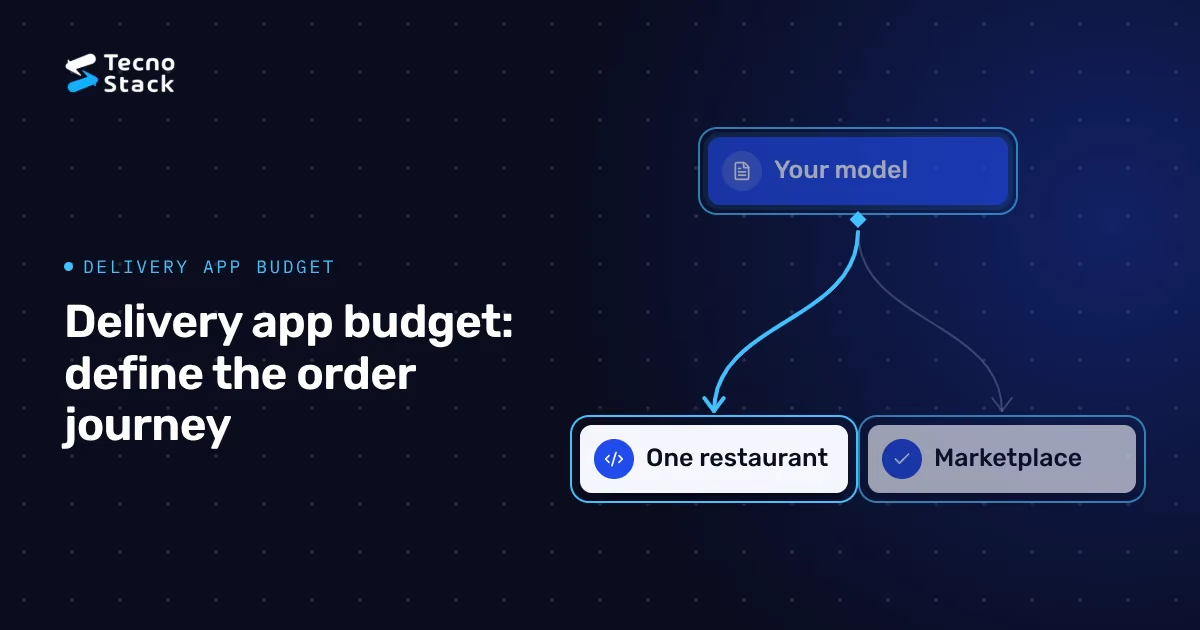
Start by describing who accepts an order, who delivers it and who handles a refund. A restaurant taking orders for its own kitchen has different requirements from a marketplace onboarding independent restaurants. Give suppliers the same operating brief before comparing their totals.
Use published prices to understand the supplier's starting scope. Ask the supplier to map your delivery workflow to that scope and price the gaps. TecnoStack's catalog lists the following general project starting prices as of October 2026; the accompanying service details define the limits.
| General app plan | Starting price before applicable VAT | Relevant scope boundary |
|---|---|---|
| Focused app | SAR 20,000 | Up to 10 screens, one user role, two existing documented APIs |
| Cross-platform app | SAR 40,000 | Up to 25 bilingual screens, admin for up to three record types, up to three integrations |
| Connected product | SAR 70,000 | Up to 25 bilingual screens, up to three roles and six documented integrations |
These plans cover iOS and Android in Arabic and English. Their published terms allow the included booking/contact form to become an order-request form within the same allowance. That does not establish a complete restaurant marketplace, courier app or dispatch system. Ask which ordering steps, permissions and operational tools your proposal includes.
For food delivery app development cost Saudi Arabia, bring a role-by-role brief so we can identify the appropriate starting scope. You can also consult the published project price catalog. Our general app budget and scope guide explains the wider app purchasing decision; this guide concentrates on delivery operations.
Decide who sells the food and controls the menu before choosing features. For a single restaurant, you might propose one menu, one preparation team and a defined delivery area. Write down how staff pause ordering, mark an item unavailable and reject an order they cannot fulfil. Treat this as a proposed first release, not a standard package.
For a marketplace, ask suppliers to price restaurant onboarding, separate staff permissions, menu ownership and order visibility. Define who collects payment and how your finance team reconciles amounts owed to each restaurant. Request a provider review of the intended payment arrangement before treating any settlement automation as available.
A chain introduces another decision: does the customer select a branch, or does your team assign one? Specify whether branches share menus, prices and stock status. Include the behaviour when the selected branch closes after a customer starts a basket. These rules give a developer something testable to estimate.
Avoid requesting a named competitor's entire app as the specification. List the journeys you need in the first release and the operations you will handle manually. Ask the quote to identify the exclusions so a later discussion does not turn an assumption into unplanned work.
Break the quote into customer, restaurant, courier and administration responsibilities. You may combine some interfaces or keep a task manual, but identify who performs each action. The following worksheet describes decisions to make; it does not promise four separate applications within a published plan.
| Work area | Define in the brief | Acceptance example |
|---|---|---|
| Customer ordering | Menu options, basket, address, payment and order status | Customer sees the accepted items and delivery address |
| Restaurant operations | Accept/reject, preparation status and item availability | Staff can reject an unavailable item using the agreed policy |
| Courier work | Assignment, pickup, delivery confirmation and failed attempts | Dispatcher can see who owns the active delivery |
| Administration | Permissions, cancellations, refunds and exports | Authorised staff can trace the order and payment history |
| Shared backend | Order states, integrations and audit records | All interfaces show the same confirmed order state |
Ask the supplier to identify shared work once. If the restaurant panel and customer app use the same order service, the proposal should explain that boundary. Request separate allowances for screens, roles and integrations, and ask how revisions affect those allowances.
Include empty, loading and failure states in the design estimate. A polished menu screen leaves important work undefined if nobody has designed a declined payment, an unavailable address or an order waiting for restaurant acceptance.
Choose the first dispatch method and describe the fallback. A proposed pilot could let a dispatcher assign orders manually. If you want automatic assignment, specify the rules: availability, delivery area, reassignment and what happens when nobody accepts. Ask for an estimate against those rules instead of a line labelled “smart dispatch.”
Separate a map showing an address from continuous courier tracking. As of October 2026, TecnoStack's service details include an on-demand last-known-location map view in the two larger plans, within their limits; continuous fleet tracking is separate. A live moving courier marker therefore needs an explicit scope discussion.
Ask the team to demonstrate permission denial, poor connectivity and a courier returning from the background. Agree what the customer sees when the latest location is old. Decide who can see location history and how long your business needs to retain it, then include those decisions in the design and privacy review.
If you are choosing between a browser experience and installed apps, use our device capability comparison for app buyers. Test the actual courier workflow on the intended devices before selecting the delivery approach.
Write the payment and order states together. Decide when the customer pays, when the restaurant accepts and who can cancel at each stage. Ask the developer to explain what happens if payment succeeds while the customer loses connectivity, or if restaurant staff reject the order after payment.
Make repeat notifications and retries part of the acceptance tests. Request evidence that repeating the same provider event does not create a second order or a second fulfilment action. Use the selected provider's documentation to agree the implementation during scoping; this guide does not assume a particular gateway or fee.
Define full and partial refunds, who can approve them and how staff confirm completion. Keep the customer message, internal order status and finance export consistent. If you plan to collect money for multiple restaurants, ask the provider to confirm the account and settlement arrangement in writing.
For mada, Apple Pay or an instalment provider, list the desired method and request confirmation of support and account approval. TecnoStack's current service terms keep provider fees separate and leave merchant approval with the provider. A development quote should distinguish integration work from the commercial agreement you make with that provider.
Keep engineering charges separate from the services you consume. Request a worksheet for hosting, map usage, messages, payment processing, store accounts and maintenance. Add the account owner, billing unit, currency and renewal date beside each provider. Leave unknown figures blank until you have a current written price.
As of October 2026, Google Maps Platform's pricing overview describes billing by service SKU and billable event under pay-as-you-go, alongside subscription options. Ask your developer which map and routing services the proposed workflow calls. Do not estimate a map bill from completed orders alone; confirm the billable events for the selected services.
Ask suppliers to show how they would estimate usage for your proposed pilot and a busier scenario. Label the inputs as planning assumptions, name who supplied them and retain the calculation. Include abandoned baskets and operational lookups where the implementation would trigger provider usage. Do not present those scenarios as measured demand.
For ongoing engineering, our post-launch support budgeting worksheet separates corrective work, compatibility updates and new features. Also budget restaurant onboarding, customer service and delivery operations internally; these are business responsibilities to allocate, not services assumed to be included in an app build.
Approve a complete order journey and its failure paths before accepting the build. Use a test menu, test accounts and the payment provider's approved test process. Record the expected result, responsible reviewer and evidence for each case.
Check an accepted order, a restaurant rejection, a cancelled delivery, an unavailable courier and a refund. Add a customer changing an address at the point your policy permits. Run simultaneous staff actions against the same order and confirm that the team can explain the final state.
Review Arabic and English menus, modifiers and receipts with your approved copy. Test long dish names, enlarged text, right-to-left forms and address instructions. Ask the restaurant operator to complete their tasks on the actual device they intend to use during service.
Agree the pilot's operating area, opening hours, support contact and stop conditions. Define who pauses ordering if your team cannot fulfil requests. Our MVP boundaries and operational ownership guide helps you turn those decisions into a release plan without committing to an unsupported scale claim.
Send a short operating brief with the restaurant model, first delivery area, intended platforms, languages and named user roles. Include sample menus, order states, dispatch rules, payment requirements and existing systems. Describe which APIs you already have and who can provide their documentation.
Ask each supplier to return the same breakdown: design, customer interface, restaurant tools, courier workflow, backend, integrations, testing, release and handover. Request assumptions, exclusions and recurring charges alongside the total. Ask for a timeline tied to approved designs and provider readiness; avoid treating a generic delivery date as a commitment for your project.
For handover, name the owner of the source code, design files, store accounts and billing accounts. Ask for release instructions, an access list and the agreed support scope. Record how the supplier prices changes after you approve the first-release requirements.
Your practical takeaway is a costed order journey with clear owners. Choose the restaurant model, price the required modules and keep provider bills visible. To prepare a proposal, send us your delivery workflow and first-release scope.


